

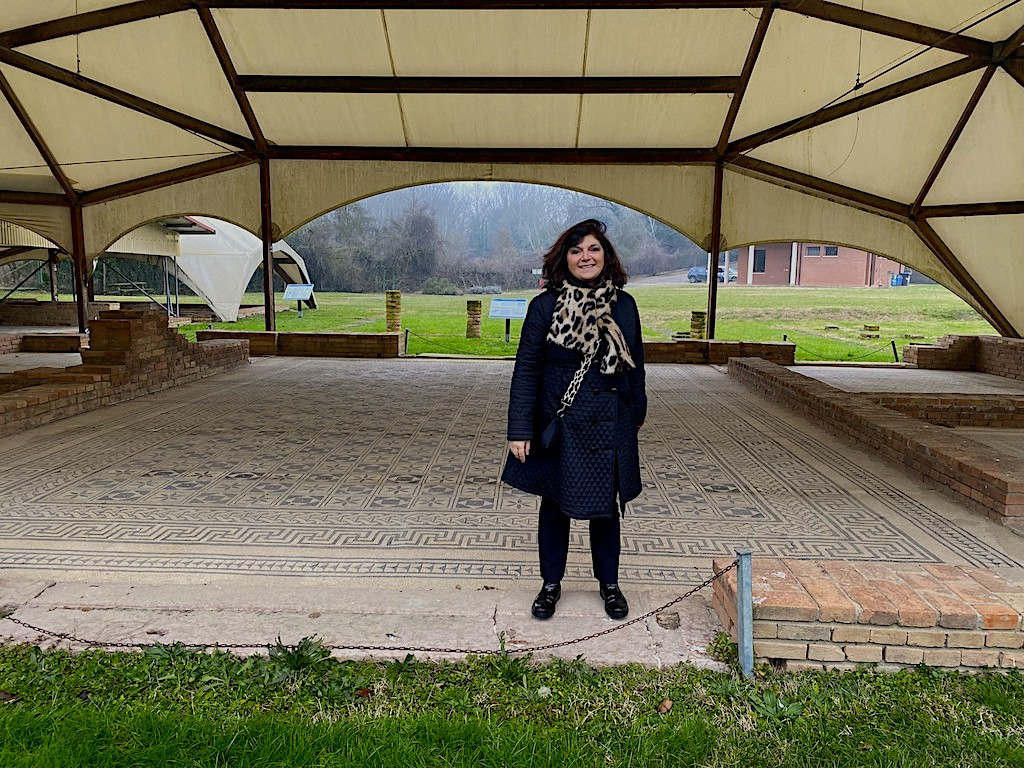
Tucked away in the quiet town of Russi, in the province of Ravenna, the Villa Romana is one of those places that gently surprises you. There is no grand entrance or dramatic fanfare, yet once inside, you realise you are standing in one of the best-preserved examples of a Roman villa urbano-rustica in northern Italy.
I was lucky enough to visit on a private tour, guided by Riccardo Morfino, editor of the local magazine Ross Zetar d’Rumagna. His deep knowledge and storytelling transformed the visit into something far more than a history lesson: it became an intimate journey through time, allowing the villa to speak not just as an archaeological site, but as a lived home.
A villa shaped by history
The villa dates from between the 1st and 4th centuries AD and belonged to a wealthy Roman landowning family. Its location was no accident. Set on slightly elevated ground near ancient communication routes between Ravenna and Faenza, the area was ideal for both residence and agricultural production. This dual function is key to understanding the site: it was a place of refined domestic life (pars urbana) and intense rural activity (pars rustica).
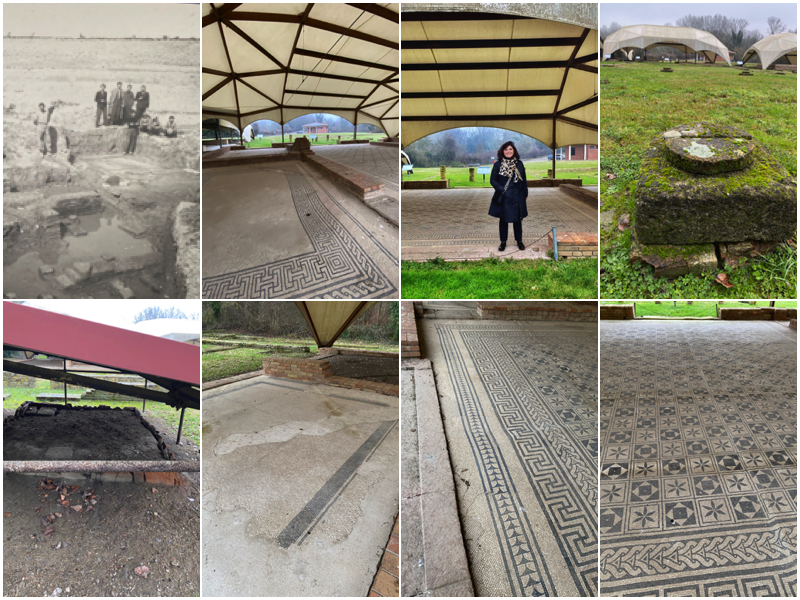
The villa was discovered entirely by chance in 1938 during clay extraction works, at an astonishing depth of 11 metres. Initial excavations revealed the thermal baths, but the outbreak of war meant the structures were reburied for protection. Systematic archaeological work resumed in the 1950s and continued in stages through to the 1990s, with significant contributions from the University of Bologna. Restoration work, including the careful repositioning of mosaics in situ, began as early as the late 1950s.
Following severe flood damage in 1996, further restoration was carried out, and in recent years protective roofing has been added to preserve the delicate mosaic floors.
Quiet luxury, Roman-style
What strikes you immediately when walking through the villa is the understated elegance. This is not loud, showy luxury, but a thoughtful balance of beauty and function. The layout reveals a sophisticated domestic rhythm: an entrance area leading to an atrium and peristyle, around which the main living quarters were arranged, while service rooms, storage spaces and agricultural areas extended to the south.
The thermal baths, located beyond the garden and orchard, underline the importance Romans placed on daily rituals of care, hygiene and social life. Even today, you can sense how these spaces were designed not just for practicality, but for wellbeing.
Mosaics as “paintings in stone”
The mosaics are undoubtedly one of the villa’s highlights. Far from being merely decorative, they tell a story of evolving Roman technology and taste. Originally, mosaic floors served practical purposes: waterproofing and durability. Over time, they became increasingly refined, transforming into what can only be described as “paintings in stone”.
Alongside mosaics, the villa also features cocciopesto flooring, made from crushed tiles and mortar, and areas paved with bricks arranged in repeating patterns. In some spaces, traces of opus sectile remain, a luxurious technique using coloured marble and stone imported from across the Mediterranean. Seeing these details up close makes it clear just how global Roman material culture already was.
A personal impression
Walking through the villa privately, away from crowds, felt almost meditative. There was a sense of slipping into another tempo of life, where domestic space was carefully choreographed around light, movement and daily routines. With Riccardo’s explanations, the ruins stopped being fragments and became rooms again: places where people walked barefoot, talked, rested, worked and cared for their land.
For families visiting Emilia-Romagna, the Villa Romana di Russi offers a wonderful opportunity to introduce children and teenagers to Roman history in a tangible, accessible way. It is compact enough not to overwhelm, yet rich enough to spark curiosity and conversation.
Quietly powerful and deeply evocative, this villa is a reminder that history does not always shout. Sometimes it whispers – and if you take the time to listen, it stays with you long after you leave.
Practical information
Villa Romana, Russi (Ravenna)
Dating: 1st–4th century AD
Type: Roman villa urbano-rustica
Managed by: Comune di Russi
Tickets available from here.
A hidden gem well worth seeking out – especially if you enjoy history that feels human, lived-in and unexpectedly moving.

Monica Costa founded London Mums in September 2006 after her son Diego’s birth together with a group of mothers who felt the need of meeting up regularly to share the challenges and joys of motherhood in metropolitan and multicultural London. London Mums is the FREE and independent peer support group for mums and mumpreneurs based in London https://www.londonmumsmagazine.com and you can connect on Twitter @londonmums
