

Born on 16 December 1775, Jane Austen turned 250 in 2025 and, true to form, the celebrations have refused to end on time, with festivals, exhibitions and Austen-mania happily spilling over into 2026 for a writer who never goes out of style.
Two hundred and fifty years after her birth, Jane Austen remains one of the most read, loved and quietly revolutionary writers in English literature. No dragons, no dramatic deaths, no sweeping battles – and yet, generation after generation, we return to her novels as if they were written yesterday.
Why? Because beneath the polite conversations, drawing rooms and courtships, Austen was doing something radical: she was observing human behaviour with razor-sharp intelligence and a mischievous sense of irony.
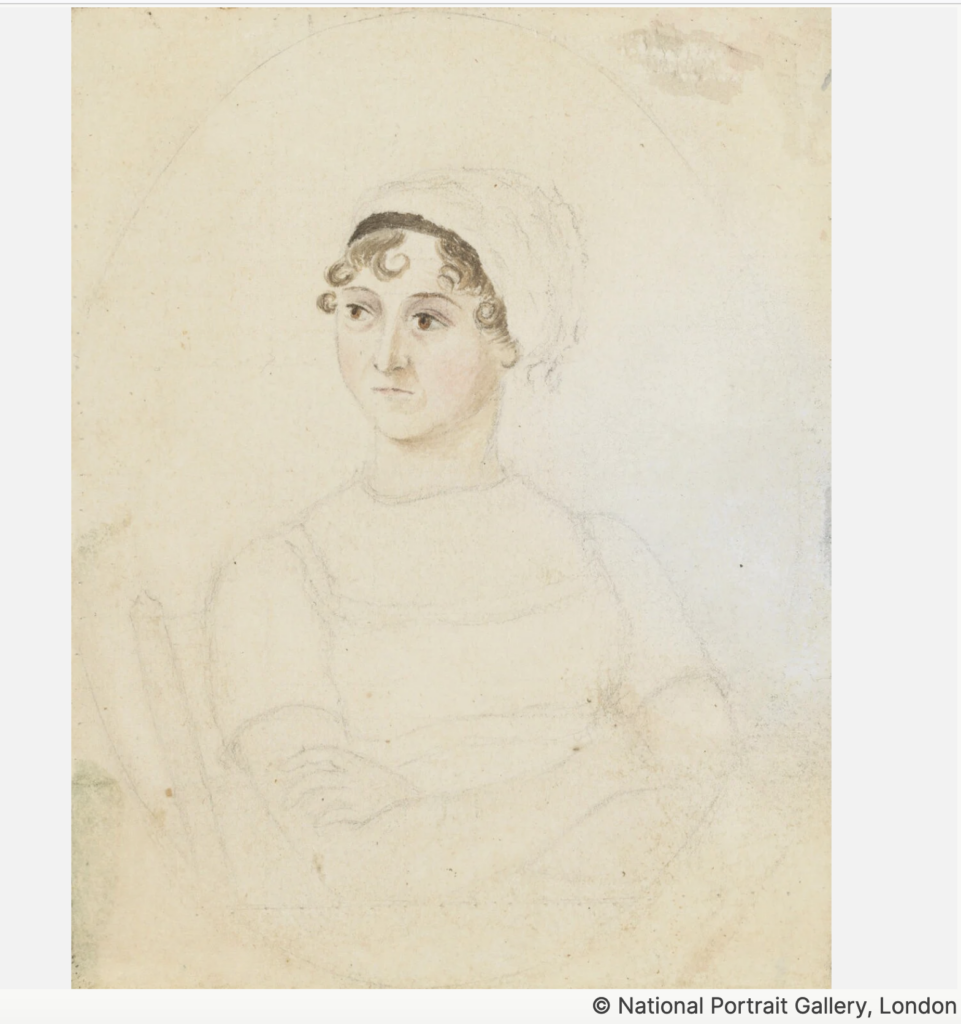
by Cassandra Austen?pencil and watercolour, circa 1810?4 1/2 in. x 3 1/8 in. (114 mm x 80 mm)?Purchased with help from the Friends of the National Libraries, 1948?Primary Collection?NPG 3630
The power of looking closely
Jane Austen wrote about what she knew: families, money, social rules, marriage and – above all – women navigating a world where choices were limited but expectations endless. Her genius lies in how she exposed the absurdities of society without ever raising her voice.
She didn’t need drama to create tension. A glance, a letter, a carefully chosen word could change everything. Her humour is subtle, her criticism elegant, and her insight startlingly modern.
Acumen and irony: her secret weapons
Austen’s novels are often described as romantic, but they are also deeply analytical. She understood how pride disguises insecurity, how prejudice masks fear, and how love requires self-awareness as much as passion.
Her irony is never cruel – it’s observant. She smiles at human weakness while inviting us to recognise our own. That’s why her characters feel so familiar. We know an Emma. We’ve met a Mr Collins. We may even have been a little Darcy ourselves at times.
Jane Austen and the Janeites
Austen’s devoted readers are affectionately known as Janeites, and they include some of the greatest literary minds in history. One of the most notable was Virginia Woolf, who admired Austen’s precision, restraint and emotional intelligence.
Woolf recognised what many dismissed for years: Austen’s apparent simplicity was, in fact, mastery. Writing with such clarity, balance and irony requires immense control – something Woolf herself deeply valued.
Why Jane Austen still matters today
In a world of constant noise and speed, Austen reminds us of the power of attention. She teaches us to read between the lines, to question social norms, and to understand that personal growth often comes from self-reflection rather than grand gestures.
For modern readers – and especially for women – her work continues to resonate. She wrote about emotional labour, financial dependence, reputation and autonomy long before we had names for them.
A legacy that feels like home
Perhaps the greatest achievement of Jane Austen is this: her books feel like companions. We return to them not just for the stories, but for the comfort of her voice – intelligent, ironic, humane.
Two hundred and fifty years on, Jane Austen still sees us.
And we, happily, keep reading.
Related articles

Monica Costa founded London Mums in September 2006 after her son Diego’s birth together with a group of mothers who felt the need of meeting up regularly to share the challenges and joys of motherhood in metropolitan and multicultural London. London Mums is the FREE and independent peer support group for mums and mumpreneurs based in London https://www.londonmumsmagazine.com and you can connect on Twitter @londonmums
