

From the precision of aeronautical engineering to the delicacy of a mascarpone cream: Giuseppe Dell’Anno, chef and winner of Bake Off 2021, recounts a journey built on rigour, passion, and Italian identity. Between world tiramisù records, family memories, food as a cultural language, and a gentle pushback against clichés, this interview is an authentic portrait of what it means to bring Italy to the world today – with seriousness, elegance, and substance.

Monica: For you, Giuseppe, what’s more stressful: the Bake Off tent or a 300-meter-long tiramisù in London?
Giuseppe: Both come with tight timelines and deadlines. Bake Off is stressful because everything has to be done against the clock, within deadlines that are always shorter than you’d need. That’s what opens the door to those kitchen “disasters” that make for good TV. For the record tiramisù, we’ll have two days, but the task is monumental. The difference, perhaps, is that this will be a community effort, with so many hands helping out. Not to mention the calibre of the pastry chefs involved… I feel like I’m in good hands. I’m the one who knows the least among them. I don’t have formal training: what I know, I learned from my father, a pastry chef, and from pure passion. For me, spending time in the kitchen is the most relaxing thing there is.
Monica: Pastry, with its precise measurements, is a bit like applied engineering. My son, when he was little, used to weigh everything meticulously. His cookies were perfect; mine were disasters. In fact, he’s becoming an engineer while I’m a writer…
Giuseppe: I agree. It requires a precise, systematic mindset. I was exactly like that as a child. With four basic ingredients, you can make anything: the difference between a sponge cake and a biscuit lies in the exact quantities and the methodology. This is especially true in Italian pastry, which isn’t as forgiving as the Anglo-Saxon style. They have baking powder and the “all-in-one mix” method. We don’t: if your method is wrong, your sponge cake turns into an omelette. The same goes for tiramisù, the first dessert I learned to make over thirty years ago with raw eggs, just like my grandmother did. Today, in restaurants, they use pasteurised eggs or techniques like pâte à bombe for safety. It’s simple, but it requires precise care.
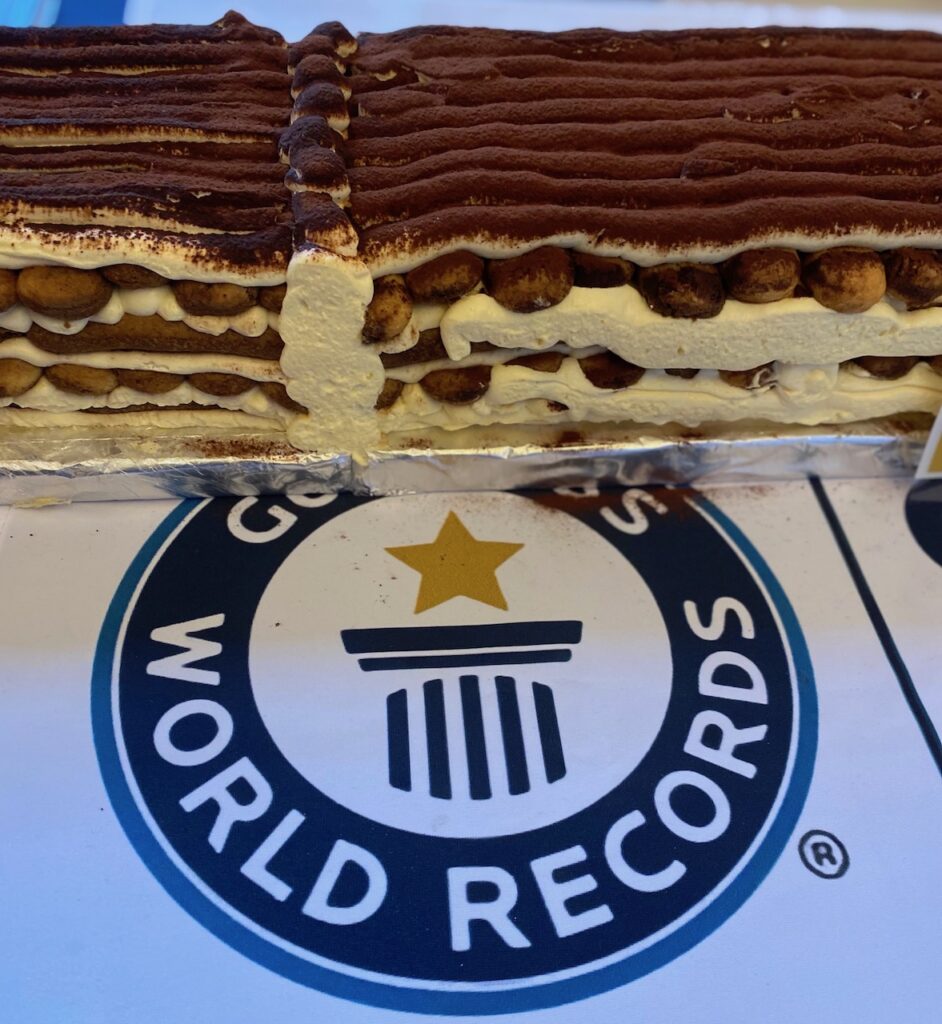
Monica: Let’s talk about the record. What are the biggest challenges for a 300-meter tiramisù?
Giuseppe: The sheer quantity and its stability. It’s not being made in a dish: if the cream is too runny and the layer falls below the 8 centimetres required by Guinness, the record is lost. Then there’s the logistics: coordinating people, ingredients, equipment. It’s pure project management, an engineering job in every sense.
Monica: Why is tiramisù so loved worldwide?
Giuseppe: For the same reason as other Italian successes like pizza: balance. It’s rich and creamy, but not cloying. The sweetness is tempered by bitter coffee and cocoa. It has an elegant richness, not a heavy one. It’s indulgent but never excessive.
Monica: Back to you. You risked a “national disgrace” on Bake Off while working as an engineer for clients like Airbus. Why take that risk?
Giuseppe: Exactly. I thought: if I can’t even make a cake on TV, my clients will think, “How can he possibly build an aeroplane?” I was staking my professional reputation. After winning, I left a great senior management job in Italy to write the book and become a pastry chef full-time. My mother didn’t speak to me for months! Now I work part-time as an engineer and part-time as a pastry chef. It was a choice driven by passion.
Monica: Let’s talk about authenticity and stereotypes. Italian elegance lies in sobriety, but the market sometimes wants something else.
Giuseppe: That’s true. For wedding cakes, I propose delicate, Italian flavours that people like. But if I propose a chocolate and caramel cake, it sells out instantly. It’s hard to defend the line of simplicity when so few fully appreciate it.
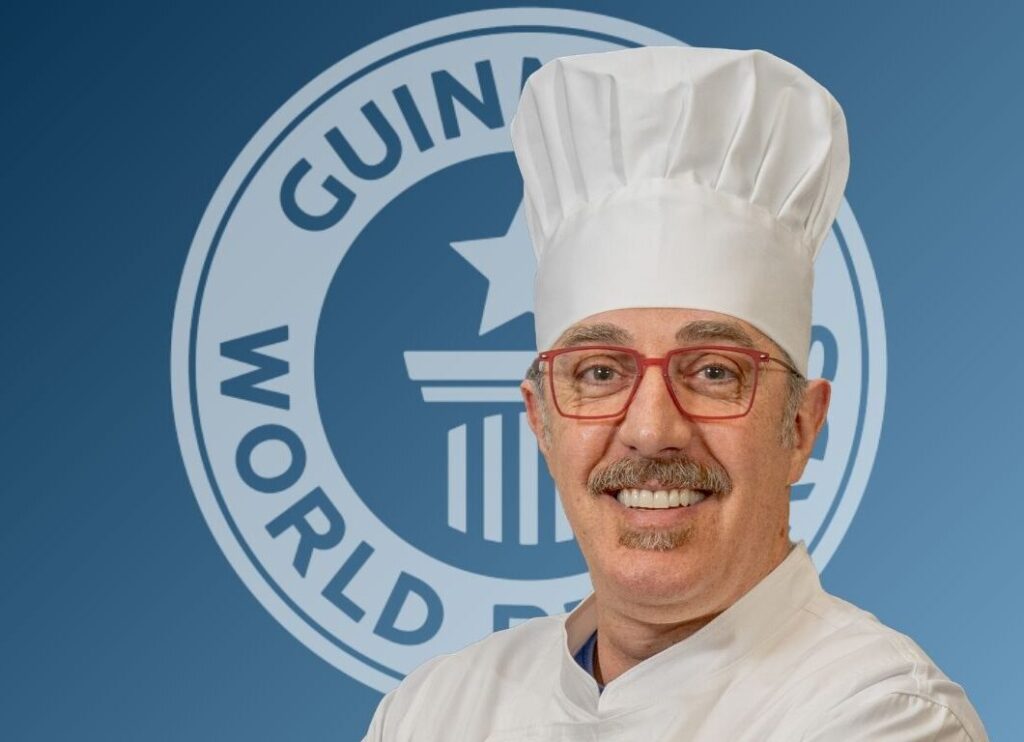
Monica: Thorny question: cream in tiramisù, yes or no?
Giuseppe: The original recipe doesn’t include it. I don’t add it at home, but I don’t condemn those who do for stability or taste. Cuisine, like language, evolves. We must preserve the knowledge of authentic recipes without being pedantic. If you like carbonara with cream, make it that way – but know how the “canonical” one came to be. Authenticity can be an elusive concept. Carbonara itself was born from creativity and necessity (eggs and bacon from American rations during the war). My father once made a “salmon pasta” using tuna and smoked hot dogs, and it was delicious. Creativity is part of a living tradition.
Monica: What’s your first memory of tiramisù?
Giuseppe: I was about twelve. My cousin taught me how to make it at my grandmother’s house. I remember the corner of the kitchen and the electric whisks for beating the eggs. It was the first dessert I ever learned to make.
Monica: And your favourite dessert, to eat and to make?
Giuseppe: Pastiera. It’s my absolute love. The scent of orange blossom and homemade candied fruit is intoxicating. It takes me back to childhood: at Easter, my father used to make dozens to give away. It’s a dessert that is tradition, memory, and fragrance all in one.
Monica: The “Longest Tiramisù” unites Italy and Britain. How powerful is food as a cultural bridge?
Giuseppe: There’s nothing more effective. Around a table, social barriers come down; we become more equal. It’s one of the most powerful channels for creating genuine connections.
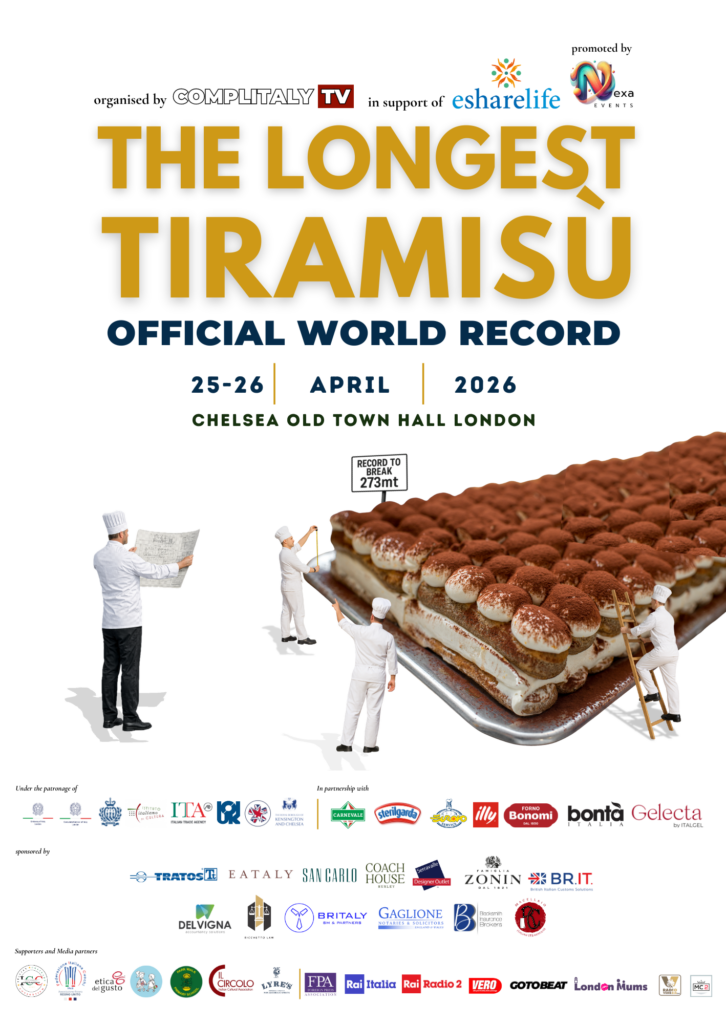
Monica: What do you hope people take home from this event, besides a slice of tiramisù?
Giuseppe: The discovery of a serious, non-stereotypical Italian professionalism. They’ll see chefs like Iginio Massari and others, totally focused and organised with “German-like” precision. I hope it shows a competent, rigorous Italy that often works behind the scenes.
Monica: If a child wants to become a chef, where should they start?
Giuseppe: They must try, copy, experiment. You only really learn by doing. But be careful about your sources: what looks good on TikTok isn’t always good to eat. Passion finds its path when it meets talent.
Monica: Rule number one if something goes wrong at the last minute?
Giuseppe: Don’t lose your cool. Chefs are used to high-pressure environments. You have to assess, optimise the effort you’ve already put in, and move forward. Maybe by cutting down on the coffee! (laughs)
Monica: Final, crucial question: first slice or last slice?
Giuseppe: Last slice. I don’t have a huge sweet tooth. I can resist. Now, if it were pizza, that would be a different story!
Monica: Promise that if we break the record, we’ll all celebrate together?
Giuseppe: Of course! And maybe I’ll even bring some focaccia barese with black olives.
Book your slice of the World’s Longest Tiramisù and support charity: join us at Chelsea Old Town Hall on 25-26 April 2026 for a record-breaking sweet event!
www.longesttiramisu.uk
Monica Costa founded London Mums in September 2006 after her son Diego’s birth together with a group of mothers who felt the need of meeting up regularly to share the challenges and joys of motherhood in metropolitan and multicultural London. London Mums is the FREE and independent peer support group for mums and mumpreneurs based in London https://www.londonmumsmagazine.com and you can connect on Twitter @londonmums
