

If Fuori left me thinking about Valeria Golino’s extraordinary range, then La Gioia – which I also caught during the Cinema Made in Italy festival – confirmed something I’ve long suspected: this woman is incapable of playing it safe.
Directed by Nicolangelo Gelormini and released in Italy on 12 February 2026, La Gioia (which translates to “The Joy”) is a very different beast from Fuori, yet it shares that same willingness to explore uncomfortable truths about human connection. Where Fuori was about friendship forged in adversity, La Gioia is about something much darker – a forbidden bond between a lonely teacher and her troubled student that spirals towards tragedy.
The story: When loneliness finds a dangerous echo
Gioia (Golino) is a 49-year-old French teacher living a monotonous, isolated existence in provincial Turin. She still lives with her elderly parents, sleeps in a childhood bedroom surrounded by dolls and stuffed animals, and dresses in oversized clothes that make her practically invisible. She has never known love – not really – and has long since stopped expecting to find it.
Alessio (Saul Nanni) is a 19-year-old repeat student at her high school, but his life couldn’t be more different. By night, he dresses “like a dream” (his own words) and sells his body to older clients, supporting himself and his fragile mother Carla (Jasmine Trinca), a supermarket cashier with a toxic relationship with a shady older man (Francesco Colella).
When Gioia agrees to give Alessio French lessons, something shifts. For her, he represents passion, youth, escape – everything her grey existence lacks. For him, she represents… what? Stability? Genuine affection? A way out? It’s never quite clear, and that ambiguity is precisely the point.
What follows is a relationship built on mutual misunderstanding – she dreams of love, he dreams of money and freedom – and it ends exactly as badly as you’re already dreading.
Inspired by tragedy
La Gioia is freely inspired by a real and heartbreaking case: the 2016 murder of Gloria Rosboch, a 49-year-old teacher from Castellamonte near Turin, who was killed by a former student she had trusted. The film doesn’t set out to be a precise reconstruction – director Nicolangelo Gelormini has emphasised that he wanted to explore the emotional truth behind the headlines rather than deliver a dry true-crime docudrama.
The screenplay, which won the prestigious Premio Solinas in 2021, was adapted from the play Se non sporca il mio pavimento by Giuliano Scarpinato and Gioia Salvatori. Gelormini, who previously directed the acclaimed Fortuna, brings a delicate touch to devastating material, refusing to judge his characters even as their choices lead them towards catastrophe.
What makes it extraordinary: The performances
Let’s talk about that transformation.
Valeria Golino is, by any measure, a beautiful woman. Everyone knows this. So what does Gelormini do? He hides her. Behind oversized glasses, frumpy cardigans, mousy hair, and an invisible wardrobe that swallows her whole. The result is startling: Gioia is someone you’d pass on the street without a second glance, which is exactly the point.
Golino has spoken openly about how confronting this was. “It’s the first time in a film that this has happened to me,” she told Il Messaggero. “A little light is enough to highlight the asymmetries that age begins to give you. But it scared me and disturbed me”. That vulnerability translates directly to the screen. Her Gioia is achingly, painfully real – a woman who has spent her whole life waiting and suddenly can’t wait another moment.
Saul Nanni, as Alessio, matches her beat for beat. His character could easily tip into caricature – the beautiful, corrupted young man – but Nanni finds something more interesting. His Alessio is simultaneously calculating and lost, a boy who has learned to survive by selling himself but has no idea how to actually live. The scene where Gioia asks if he dresses as a woman and he replies, “No, I dress like a dream,” encapsulates everything heartbreaking about him.
Jasmine Trinca, as Alessio’s mother Carla, deserves special mention. She plays a woman so desperate to remain young and desirable that she’s effectively abandoned any real connection with her son. It’s a small role but a devastating one.
The image that haunts
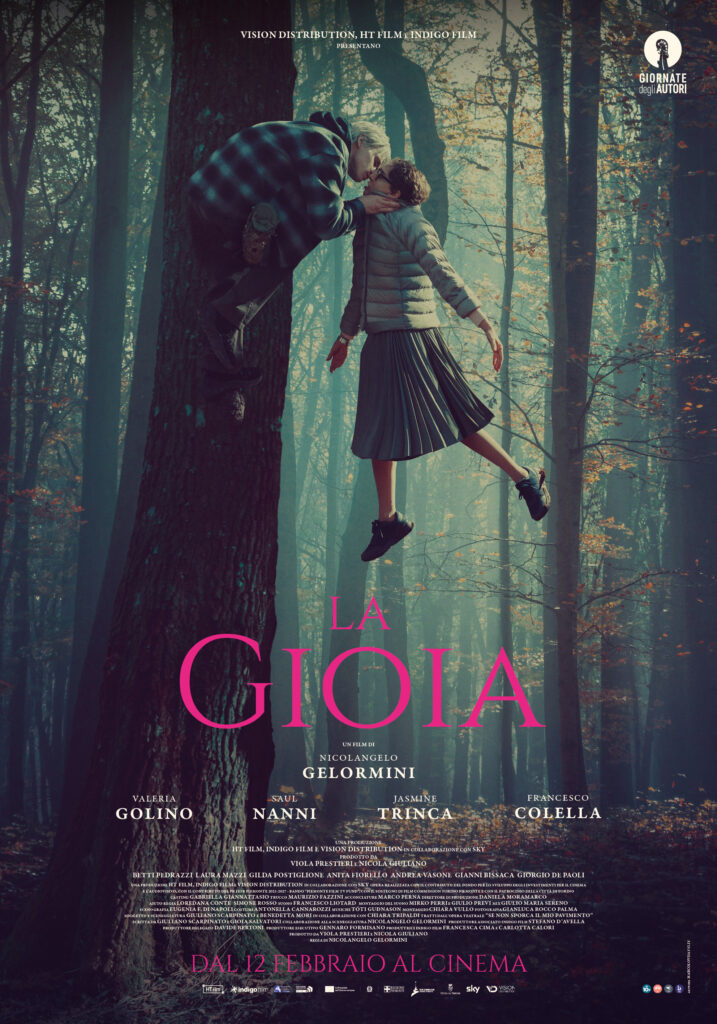
There’s one image from La Gioia that I genuinely can’t shake. The promotional poster shows Gioia and Alessio locked in a kiss, suspended mid-air against a tree like figures from a Magritte painting. It’s surreal, beautiful, and deeply unsettling – because even as they embrace, you know they’re falling.
That kiss never quite lands. Neither do they.
Connecting the dots: Two films, one extraordinary actress
Watching Fuori and La Gioia back-to-back, what strikes me most is how Golino finds the humanity in women society might prefer to overlook. Goliarda Sapienza was a brilliant writer dismissed in her lifetime. Gioia is an invisible woman desperate to be seen. Both could so easily be reduced to their circumstances – the thief, the victim – but Golino refuses to let that happen.
She brings to both roles what she’s brought to every performance since Rain Man: an unshakeable belief that even complicated, messy, difficult women deserve to have their stories told.
As she told Leggo about La Gioia: “They are all victims of themselves, of the lack of tools, or of the projection we make onto others. The only thing that survives is the title: that very brief moment of fullness for which Gioia risks everything”.
The mum verdict on La Gioia
Is La Gioia an easy watch? Absolutely not. It’s a film about loneliness, exploitation, and the terrible things people do when they’re desperate to be loved. There’s no comfort here, no neat resolution, no catharsis – just the quiet devastation of lives that never had a chance.
But it’s also a film of extraordinary tenderness. Gelormini directs with compassion rather than judgement, and Golino… well, Golino reminds us why she’s one of the finest actors working today.
If you get the chance to see it when it arrives in UK cinemas (keep an eye on distribution announcements), go prepared. And maybe bring tissues.
Monica Costa founded London Mums in September 2006 after her son Diego’s birth together with a group of mothers who felt the need of meeting up regularly to share the challenges and joys of motherhood in metropolitan and multicultural London. London Mums is the FREE and independent peer support group for mums and mumpreneurs based in London https://www.londonmumsmagazine.com and you can connect on Twitter @londonmums
