

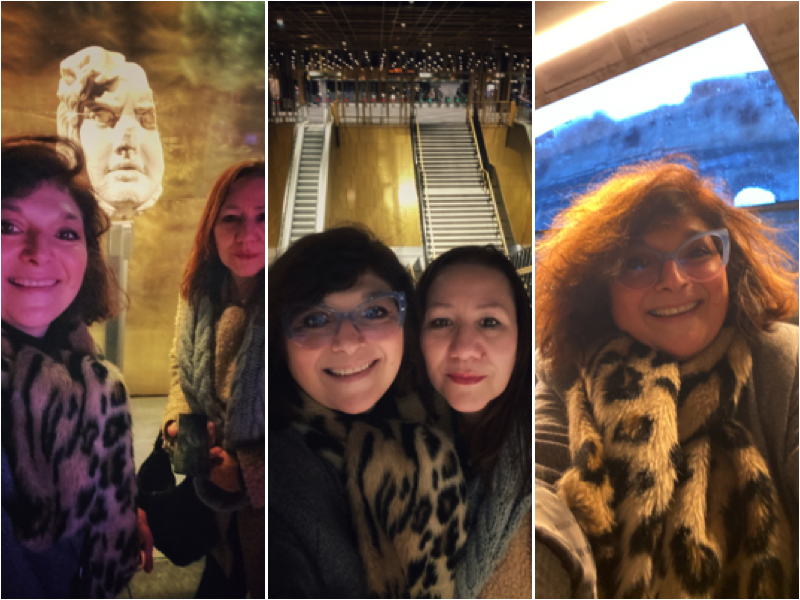
If you think the London Underground has a lot of history, wait until you hop on Rome’s Metro C. This isn’t just public transport – it’s a time machine, an archaeology lesson and a design statement all rolled into one very efficient commute. My friend Donatella and I recently checked it out.
Rome is a city where every hole in the ground risks uncovering a Roman villa, a military barracks or something last used by Julius Caesar. Building a modern metro line here was never going to be straightforward. Yet somehow, Rome has pulled off something rather extraordinary: a metro line that doesn’t fight its past, but proudly puts it on display.
Welcome to Metro C, the green line that has quietly become one of the most unexpected attractions in the Eternal City.
A Metro… or a Museum?
The newest central stations on Metro C- San Giovanni, Porta Metronia and the spectacular Colosseo – Fori Imperiali -have earned the nickname “station museums”. And it’s easy to see why.
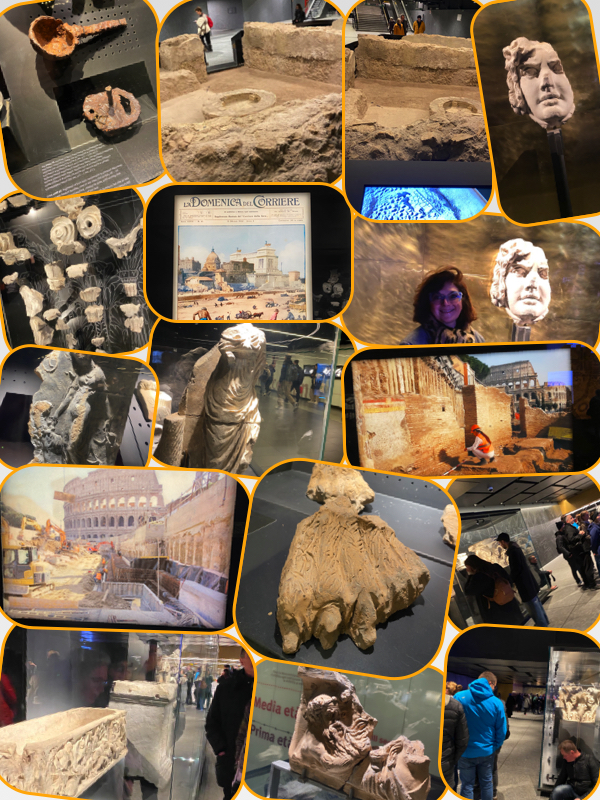
While waiting for your train, you can admire ancient Roman remains displayed in situ, exactly where they were found during excavation works. At Porta Metronia, archaeological finds such as a Roman military barracks and large ancient water basins sit behind glass panels in the station’s atrium. No ropes, no queues, no ticket surcharge – just history casually built into your daily journey.
For families travelling with children (or curious teens who usually groan at the word “museum”), this is a genuine win. You’re not dragging them around ruins in the heat – the ruins come to you, underground, air-conditioned, and free.
Where Ancient Rome meets contemporary design
One of the joys of Metro C is the striking contrast between old and new. The stations themselves are boldly modern: spacious, impeccably clean, well-lit and finished with sharp architectural lines. Then, suddenly, there’s a 2,000-year-old wall or a Roman road emerging from beneath your feet.
The effect is dramatic without being gimmicky. Instead of hiding Rome’s layers, the architects and engineers have leaned into them, creating a journey that feels both futuristic and deeply rooted in the past.
If you’re used to squeezing onto Victorian-era platforms in London, this metro will feel positively sci-fi.
Why Metro C matters (Beyond Tourism)
Metro C isn’t just a pretty project. It’s a major piece of sustainable urban infrastructure designed to connect Rome from south-east to north-west, linking suburban areas with the historic centre.
When completed, the line will stretch approximately 29 kilometres, with 31 stations, running from Monte Compatri/Pantano to Farnesina, near the Foro Italico. Around 20 kilometres are underground, a necessity in a city layered with millennia of history.
Currently, the line operates from Pantano to San Giovanni, with 22 stations already in service. New stations opened to the public in December 2025, including Porta Metronia and Colosseo – Fori Imperiali, with others – such as Venezia, San Pietro and Ottaviano – in various stages of development.
The result? Better mobility, fewer cars in the centre, and easier access to Rome’s most important cultural sites.
A boom in visitors (Yes, even locals)
Metro C’s new stations have quickly become a destination in their own right. According to Rome’s transport authority ATAC, around one million people visited the new stations in just one month.
What’s fascinating is that this isn’t just tourist traffic. Roughly 50% of visitors are local residents, many using their weekend leisure time to explore the stations – turning a metro stop into a Sunday outing. In Rome, even commuting can become a passeggiata culturale.
The Colosseo – Fori Imperiali station alone recorded over 360,000 visitors, with peak days during the Christmas holidays seeing more than 22,000 people passing through in a single day.
Not bad for a metro stop.
Perfect for families and curious travellers
For London Mums readers planning a trip to Rome, Metro C offers an easy, affordable way to mix education, culture and practicality.
- Travelling with children? It’s a hands-on history lesson without the pressure.
- Visiting with teens? The “cool factor” of underground archaeology usually wins them over.
- Short on time? You can experience Roman history between stops.
And let’s not forget the big plus: it’s included in your normal transport ticket. No museum queues, no extra planning, no budget blowout.
Rome, Reinvented Underground
Metro C proves that Rome doesn’t have to choose between preserving its past and investing in its future. It can – and clearly does – do both.
This green line is a jewel of modern engineering, a celebration of archaeology, and a reminder that in Rome, even the most ordinary things (like catching the tube) can turn into something extraordinary.
So next time you’re in the Italian capital, don’t just walk above ground. Take Metro C – and travel through 3,000 years of history on your way to dinner.
Practical tip: allow a little extra time. You may find yourself missing a train because you’re too busy staring at ancient Rome beneath your feet.

Monica Costa founded London Mums in September 2006 after her son Diego’s birth together with a group of mothers who felt the need of meeting up regularly to share the challenges and joys of motherhood in metropolitan and multicultural London. London Mums is the FREE and independent peer support group for mums and mumpreneurs based in London https://www.londonmumsmagazine.com and you can connect on Twitter @londonmums
