

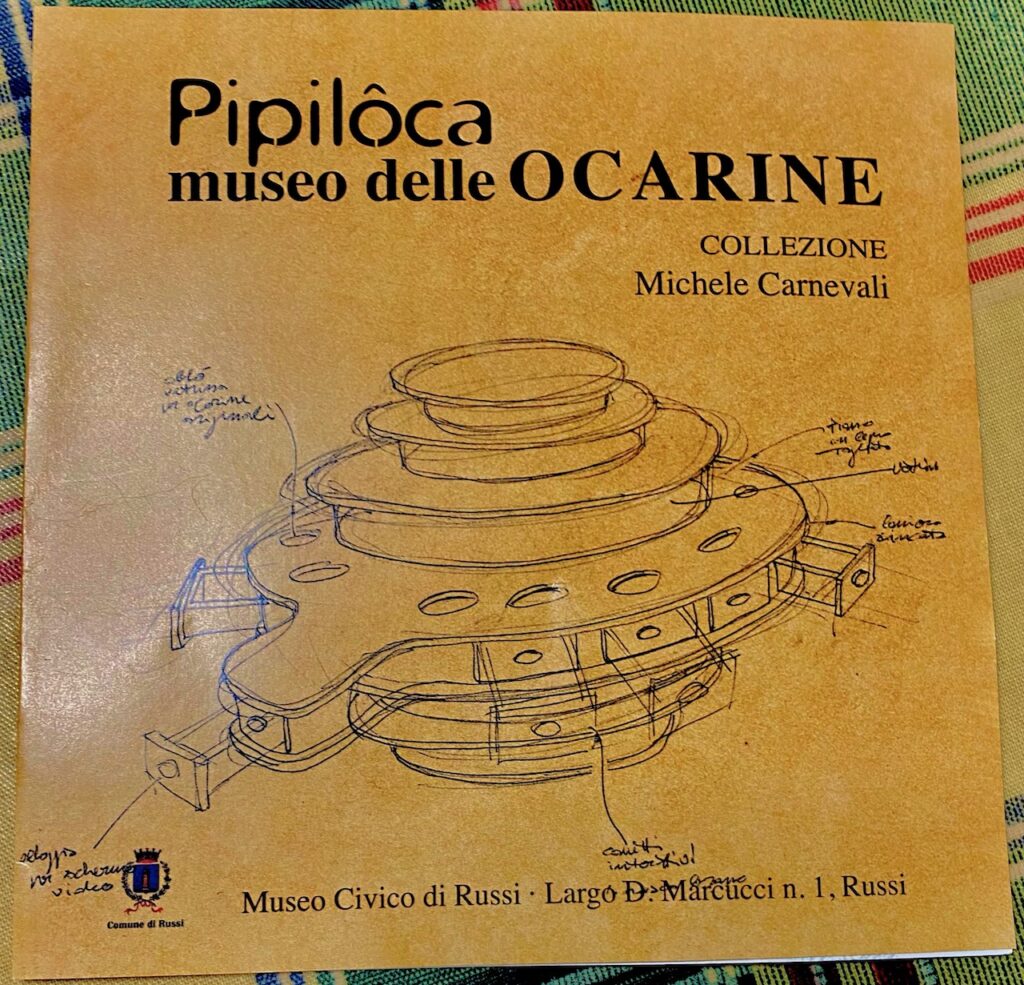
On an intensely foggy late-December morning – the kind so typical of the Romagna stretch of the Po Valley, when all you really want is to stay under the duvet with a warm mug in your hands – I instead accepted a rather special invitation. One that turned out to be a small Christmas gift: a visit to the Civic Museum of Russi (near Ravenna, Italy), where the Ocarina Museum – Michele Carnevali Ocarinas Collection, also known as Pipilôca, has recently opened.
I was accompanied by Maestro Michele Carnevali, known as Gianni, and a representative of the Pro Loco of Russi. I had no idea that what seemed like a simple visit would move me quite so deeply.
There is, however, one detail that makes this museum even more special for me personally: the Civic Museum of Russi is located in Largo Dante Marcucci, number 1.
Dante Marcucci was my grandfather – a much-loved doctor in the area, to whom this central street (perhaps the most beautiful in town) was dedicated, along with the nearby health clinic. Walking there, entering a place that bears his name, filled me with a profound sense of pride. A story worth telling another time.
But back to the ocarinas.
The Ocarina Museum is small and intimate, yet utterly enchanting. It is a place that isn’t simply meant to be seen: it is listened to, experienced, and felt. An interactive museum that captivates adults and children alike, scholars and curious visitors.
The ocarina – a small globular flute made of terracotta – was born in Budrio in 1853, from the hands of a young musician and craftsman, Giuseppe Donati. Almost a playful invention at first, born from creative experimentation, it went on to become a recognisable voice across the world. Ethnomusicologist Curt Sachs described it as an instrument “without pretension”, yet its sweet, hypnotic and deeply human sound has travelled through centuries, continents and cultures, reaching as far as Asia and Korea.
The Carnevali Collection, generously donated to the Municipality of Russi, includes over fifty ocarinas, differing in shape, colour, material, era and origin. Some are genuine pieces of history. Among the most moving are the Ocarina of the First World War, played on the Carso front by Giacomo Bagnari and still miraculously intact, and the ocarina bearing the effigy of Vittorio Emanuele II, dating back to the mid-19th century.
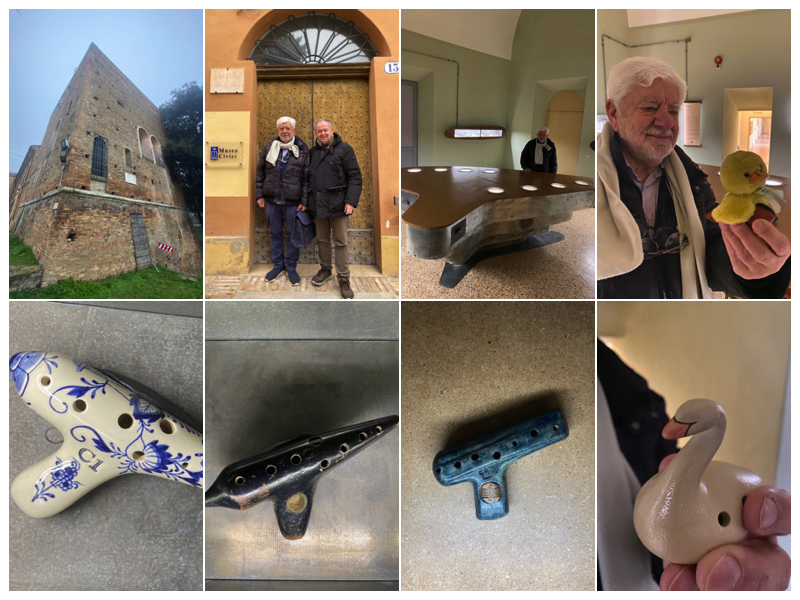
The exhibition design – curated by Gianni Zauli and Claudio Ballestracci – is a delightful surprise: a large installation shaped like a giant ocarina, complete with drawers and little doors that visitors can open. Each time a drawer is pulled out, a musical piece begins to play, performed by Maestro Carnevali himself using the ocarina inside. From Ennio Morricone to Lucio Dalla, from Secondo Casadei to Vivaldi and even Glenn Miller, it is a musical journey that crosses eras, genres and emotions.
Children are mesmerised; adults find themselves smiling like children. This is a museum that doesn’t demand silence, but instead invites listening, curiosity and wonder.
And then there is Maestro Michele Carnevali himself – multi-instrumentalist, clarinettist, teacher and tireless musician. If you are lucky – as I was – he may appear during your visit and offer live demonstrations. He shares anecdotes with disarming sweetness, such as the memory of playing sugar ocarinas at the age of six, back in 1952, returning home with a mouth full of sugar and a shirt stained bright red. Simple, genuine memories that tell the story of a life devoted to music.
My visit was a private one, intense and almost suspended in time. I experienced it as a true Christmas gift from a community – that of Russi – which preserves its local culture with love, respect and dedication.
To visit the museum, you need to contact the Municipality of Russi at cultura@comune.russi.ra.it and book in advance – but trust me, it is absolutely worth it.
If you are visiting Ravenna (like King Charles did in 2025) or the surrounding area, don’t miss this hidden gem. It is one of those places that makes very little noise, yet leaves a long-lasting echo in your heart.
Monica Costa founded London Mums in September 2006 after her son Diego’s birth together with a group of mothers who felt the need of meeting up regularly to share the challenges and joys of motherhood in metropolitan and multicultural London. London Mums is the FREE and independent peer support group for mums and mumpreneurs based in London https://www.londonmumsmagazine.com and you can connect on Twitter @londonmums
