

This week, Mattel announced the launch of its first autistic Barbie, created in collaboration with the Autistic Self Advocacy Network. The move has been widely praised as an important step forward for representation, inclusivity and understanding of neuro-diversity – particularly for young people on the autism spectrum, who still too often feel unseen or misunderstood.
And at first glance, it is hard not to applaud the intention.
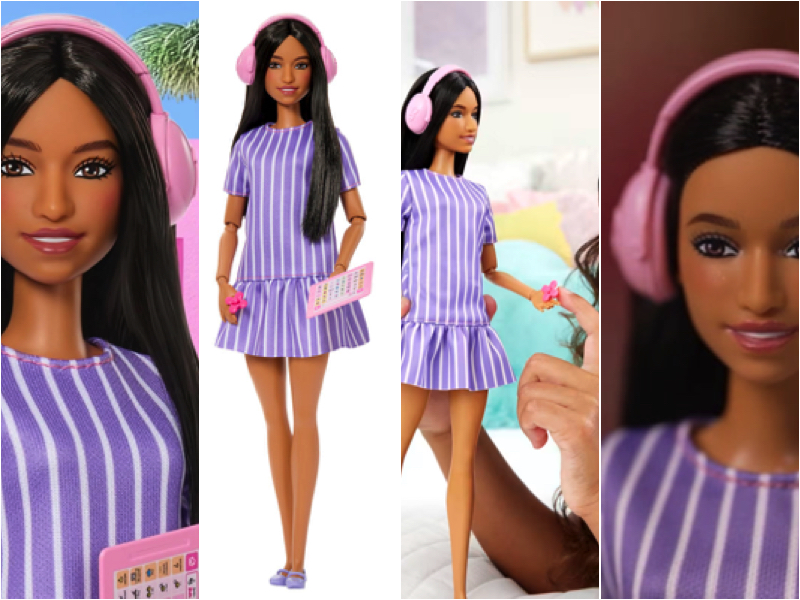
The doll includes thoughtful details: noise-cancelling headphones, a fidget toy, loose-fitting clothes designed with sensory comfort in mind. Mattel also references research from Cardiff University showing that playing with dolls can help children develop empathy and social processing skills. In a world where around 1 in 31 children in the US is diagnosed with autism by the age of eight, and where diagnoses are rising thanks to better awareness, representation clearly matters.
But – and this is where my view as both a mother and a lifelong Barbie collector becomes more complicated – good intentions do not automatically translate into good outcomes.
Representation vs labelling
Do we really need an autistic Barbie to play imagination games?
That question may sound provocative, but it comes from lived experience rather than dismissal. When I was a child, my Barbie dolls were simply… Barbie dolls. In my classroom, children who needed extra support received it, but they were not formally labelled, categorised or defined by a diagnosis in the way we often see today. They were not “othered”. They were just part of the group.
I worry that in our very well-meaning rush towards representation, we may be replacing inclusion with ever more labels.
Children do not naturally think in diagnostic categories. Adults do. And while a diagnosis can absolutely be validating and essential for accessing support, does it need to be reinforced in the imaginary, aspirational world of play?
The commercial elephant in the room
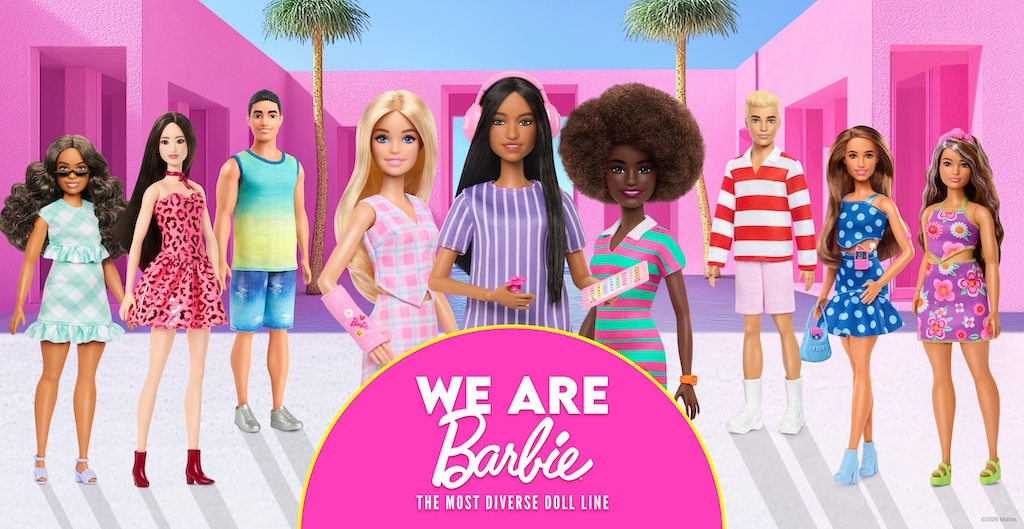
There is also an uncomfortable truth we should acknowledge: Barbie is, first and foremost, a global commercial brand. This launch is undeniably aligned with a broader trend of politically correct, socially conscious branding – and that does not automatically make it cynical, but it does invite scrutiny.
Is this about empowering autistic children, or about reassuring adults that we are “doing the right thing”?
Representation that feels organic tends to empower. Representation that feels branded, marketed and neatly packaged risks feeling performative – especially when the lived reality of autistic individuals is far more complex than a few carefully selected accessories.
Girls, autism and invisible struggles
There is no doubt that autistic girls, in particular, deserve far more understanding. Research shows that girls are diagnosed far less frequently than boys, often because they learn to “mask” – adapting their behaviour to fit social expectations. This masking can lead to anxiety, burnout and a delayed or missed diagnosis.
Awareness here is crucial. Acceptance is crucial. Support is crucial.
But I am not convinced that a labelled doll is the most powerful tool to achieve this.
A collector’s perspective
I own around 300 Barbie dolls, most of them vintage. None of them is labelled as disabled or neuro-divergent. And yet, in my imagination – and in the imagination of countless children – they were all capable, confident, adventurous, beautiful in their own way.
Because in a child’s dream world, everyone is beautiful. Everyone belongs. Everyone is allowed to be perfect, flawed, brave, strong – without explanation.
That, to me, is the quiet magic of play.
So where does that leave us?
To be clear: I am not against representation. I am against over-definition.
What young people – autistic or not – need most is not a reminder of how different they are, but a world that accepts difference without constantly naming it. Less labelling. More kindness. Less categorising. More respect.
Perhaps the real challenge is not to create a Barbie for every condition, but to build a society where children do not need to see themselves labelled in order to feel valued.
And maybe the most radical form of inclusion is this: teaching children that everyone, by default, already belongs.
Related articles
Monica Costa founded London Mums in September 2006 after her son Diego’s birth together with a group of mothers who felt the need of meeting up regularly to share the challenges and joys of motherhood in metropolitan and multicultural London. London Mums is the FREE and independent peer support group for mums and mumpreneurs based in London https://www.londonmumsmagazine.com and you can connect on Twitter @londonmums
