

More and more families across the UK are searching for ways to enhance wellbeing, improve mental health, and strengthen family connections. The recent trend of garden log cabins has introduced unique outdoor living spaces that can significantly impact families.
These multi-functional spaces help families balance remote work, personal relaxation, and quality family time — something that has become increasingly important since the pandemic. This article explores how log cabins contribute to family wellbeing in the UK through the 3-Zone Wellbeing Model.
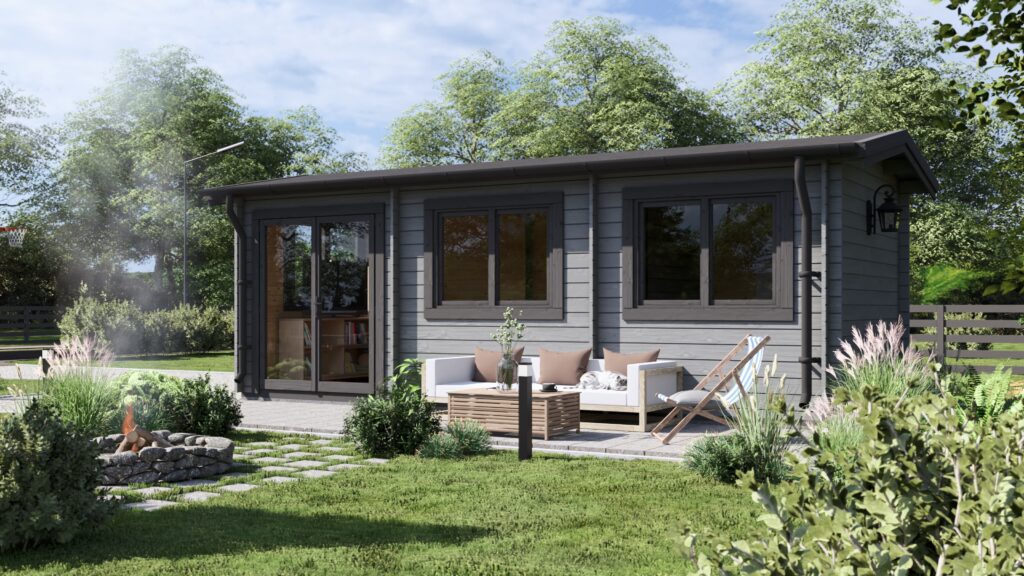
How Do Log Cabins Enhance Mental Health for UK Families?
A log cabin can help improve mental health because it creates a space for you to get away and connect with nature. Studies suggest that exposure to nature can help UK families relieve stress and enhance psychological wellbeing.
According to a recent interior study, log cabin construction’s inherent biophilic design attributes resulted in a 30% reduction in daily stress and greater concentration levels for people who live in them. This calming effect comes from biophilic principles, including the use of natural materials, natural light, and soothing surroundings.
Researchers have found that fractals commonly found in wood grain and other nature-inspired designs can change our brainwaves and reduce our stress levels by as much as 60%.
A dedicated outdoor space away from the main home can help reduce tension and provide a peaceful retreat.
A lot of cabin designs maximize natural light, which helps regulate cortisol and improve sleep patterns. Studies have found that workers with access to natural light sleep, on average, 46 minutes more each night.
Giving each family member time for quiet reflection in a log cabin away from the main home lets them decompress and enjoy mindful activities that help restore peace of mind.
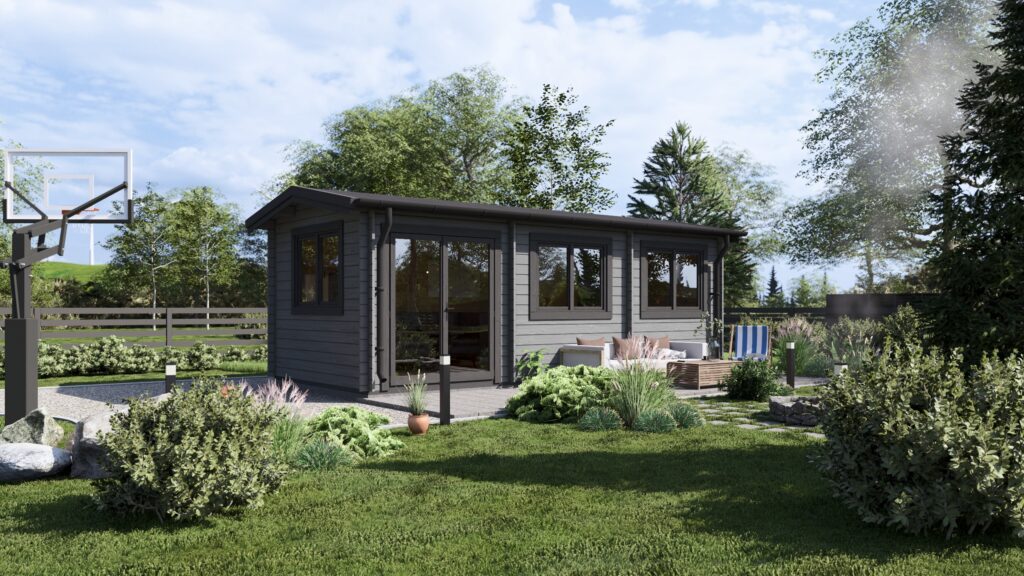
How Do Log Cabins Improve Work-Life Balance for Remote Workers?
Remote workers in the UK are finding that log cabins help improve work-life balance by creating a physical separation between work and home life. It’s important to make this separation, especially since 86% of full-time remote workers report burnout.
A garden office cabin offers a psychological “commute” for the worker when they leave the garden office cabin at the end of the day. This helps address the challenge faced by 30% of Britons who struggle to separate work and home life.
Having physical boundaries helps to resist the temptation to check emails or do extra work after hours, a challenge for 81% of remote workers.
Working in a separate space helps prevent work-related stress from affecting the family home.
Important features to look for when choosing a productive garden office are natural light, insulation that provides year-round comfort and an ergonomic set-up.
Garden offices are becoming popular, having seen a 300% increase in searches since 2020. They are certainly becoming an essential solution for remote working in the UK.
How Do Log Cabins Foster Quality Family Time?
Log cabins help families spend quality time together away from screens by providing a comfortable space for shared activities. These cabins serve as a “Connection Zone” for families to unplug and connect intentionally.
The UK government will advise that children aged 2 to 5 only spend one hour a day on screens in 2026. Log cabins provide an excellent option to promote this reduction.
Families use cabins for a variety of activities where they participate in board games, crafts, reading, and chatting with each other.
With sufficient insulation and heating, cabins can be used at any time of the year so that you can connect to the outdoors without letting the increasingly unpredictable UK weather get in the way.
One option is to create ‘teen spaces’. These are dedicated areas for older children that give them more semi-independent space for socialising or studying. They keep children happy at home, and less inclined to seek entertainment elsewhere.
These spaces play an essential role in encouraging genuine conversation while reducing digital distractions.
How Do Log Cabins Extend Outdoor Living for UK Families?
Log cabins extend indoor living into the garden, which is essential in the climate of the UK. With the right specifications, they can be used comfortably throughout the year.
If you want to create an all year round comfortable environment in the UK, log cabins require at least 75-100 mm thick high performance insulation in walls, roof and floor. With this insulation and suitable heating solutions, cabins remain comfortable and warm throughout the winter months.
To ensure durability in the UK’s climate, it is important to have a good foundational system, roofing and sealing.
To heat cabins, especially in the winter months, you can consider electric panel heaters or even underfloor heating. A well-insulated 12m² cabin can cost around £30-£70 per month to heat when using it every day.
Large windows and bifold doors maximise natural light and create a seamless connection with the garden. This offers a great space for the family to gather in or just disconnect for a while.
Log cabins encourage outdoor living regardless of the season, providing families with a comfortable extension of their home that is also weather-resistant.
What Are the Physical Health Benefits of Log Cabins?
Using a log cabin as a fitness or wellness space can support physical health and encourage a more active lifestyle. Log cabins provide dedicated spaces for exercising and encourage outdoor activities. By eliminating barriers to family workouts, they can be transformed into home gyms or yoga studios.
These outdoor structures can encourage children to stay physically active, which is important given that UK health guidelines recommend three hours of physical activity daily for children under five.
A cabin can house exercise equipment, allowing family members to relax or work out at any time without a gym membership.
A cabin located near the main garden can naturally encourage children to spend more time playing outdoors. For example, one could store the bikes there. You could also house sports equipment there.
Cabin design that allows for older family members to partake in low-impact exercise or a hobby can be quite useful in multi-generational family situations.
Thus, the strategic placement and design of a log cabin can help foster a more active and healthier lifestyle for family members.
The 3-Zone Wellbeing Model shows how log cabins can meet specific family needs.
Separation Zone: This is a dedicated garden office to provide a physical separation between work and home.
Sanctuary Zone: It’s where people go to engage in mindfulness, hobbies, or just curl up in blissful quiet. It is a decompression space that relies upon biophilic design to combat stress and induce mental calmness. It also addresses the UK’s growing mental health challenges, with 1 in 4 adults experiencing a mental health problem each year.
Connection Zone: Families can participate in screen-free activities, games and hobbies as a family. It provides a designated space that strengthens family relationships by helping to mitigate the impacts of excessive screen time and encouraging more intentional interactions.
Families with dedicated garden spaces report 34% lower household stress levels. They also enjoy 28% more quality family time.
Log cabins are not just buildings in your UK garden. They are investments in the mental health and overall wellbeing of your family. By creating dedicated spaces that act as a Separation Zone for work, a Sanctuary Zone to unwind, and a Connection Zone for family bonding, they bring real advantages to contemporary familial complexities.
Log cabins can significantly reduce remote working fatigue, encourage more screen-free family time, and promote physical activity. They are highly versatile structures thanks to their natural biophilic qualities. Many UK families are experiencing increasing daily pressures and stress. A log cabin could be the long-term answer to creating a healthier, more connected, and balanced home environment.

Monica Costa founded London Mums in September 2006 after her son Diego’s birth together with a group of mothers who felt the need of meeting up regularly to share the challenges and joys of motherhood in metropolitan and multicultural London. London Mums is the FREE and independent peer support group for mums and mumpreneurs based in London https://www.londonmumsmagazine.com and you can connect on Twitter @londonmums
