

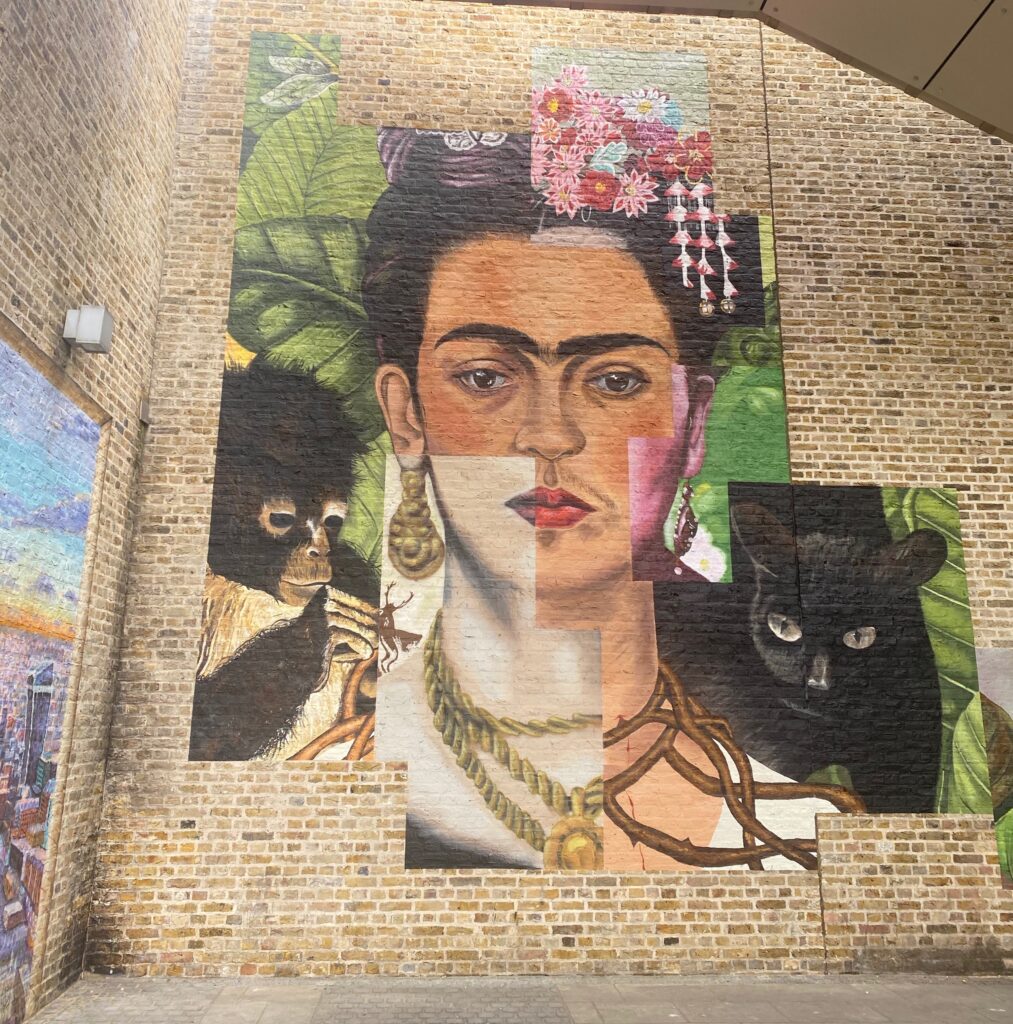
When an invitation lands promising a press view of the biggest Frida Kahlo exhibition ever staged in this country, you do not simply put on a sensible blouse and turn up. I turn up with a Frida dress, naturally (I did it also for the Mondrian exhibition). Mine came from the magical hands of Italian fashion brand Antica Sartoria, all embroidered flowers and full skirts with Frida’s image on it, and I practically floated down the South Bank feeling like I had stepped straight out of the Casa Azul. Madeleine, my equally Frida obsessed companion for the day, walked with me to Blackfriars station and within sixty seconds we were shrieking because there she was, Frida herself, staring back at us from a colossal mural right on the station wall. That unibrow. Those dark eyes. The hummingbird. I gave my skirt a Wonder Woman spin in front of it and several passing commuters cheered. London is already deep in the grip of Fridamania and the exhibition had not even opened yet.
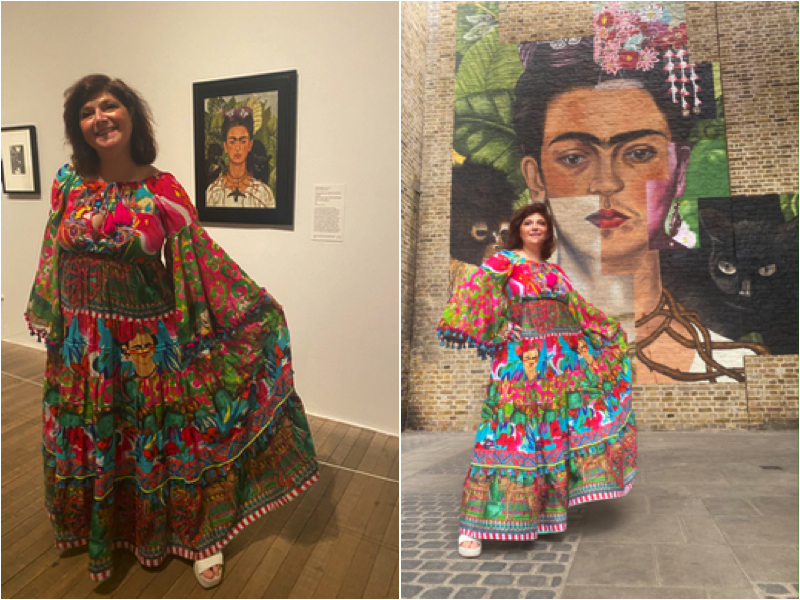
This show has spilled out of the gallery and taken over the whole city, and nothing could be more fitting for a woman who refused to be contained by a single frame, a single identity or a single lifetime.
Madeleine and I (the London Mums art critics dream team) were at Tate Modern for the press view of Frida: The Making of an Icon, which opens to the public on 25 June 2026 and runs until 3 January 2027. It has already become the highest pre-selling exhibition in Tate’s history, with over 35,000 tickets snapped up before the doors even opened. So, if you want to see this show you need to book immediately. This is not a drill. This is the art equivalent of the golden ticket.
More than a painter, more than an exhibition
What is immediately clear, and what sets this show apart from any Frida exhibition I have ever seen, is that it is not simply a greatest hits of her paintings, although the paintings are breathtaking. This is a forensic, joyful, deeply moving investigation into how a woman who died in 1954 known only to a small circle of Mexican and American intellectuals has become one of the most recognisable faces on the planet. At the time of her death, Frida Kahlo had sold only a handful of works. She had exhibited solo only twice. For most of her life she stood in the shadow of her famous husband, the muralist Diego Rivera. She never really considered herself a professional artist until very late in her career. And yet here we are, decades later, with her face on everything from tote bags to tequila bottles and over 100,000 objects bearing her image for sale online at any given moment.
The exhibition traces that extraordinary transformation through seven thematic sections and around 160 to 170 works in every medium you can imagine. Alongside Frida’s own paintings are pieces by eighteen other artists from across five generations, some her contemporaries, others born long after she died, all of whom acknowledge her as a core reference, an inspiration, a kind of artistic north star. The Surrealists, the Chicano and Chicana movement, feminists, LGBTQ activists and artists, the New Mexicanists of the 1980s and 90s, Latinx creators and, more recently, disabled artists. Frida speaks to all of them, and through them, she speaks to us.
The woman who constructed herself
One of the most fascinating threads running through the exhibition is the idea that Frida did not simply paint herself. She built herself. She created a multifaceted identity that was part artist, part intellectual, part devoted wife, part political activist, part bisexual partner, part mestiza woman proud of her indigenous heritage. She was all of these things at once, and she refused to settle into any single box. That refusal is what makes her so endlessly fascinating and what allows so many different people to find themselves in her.
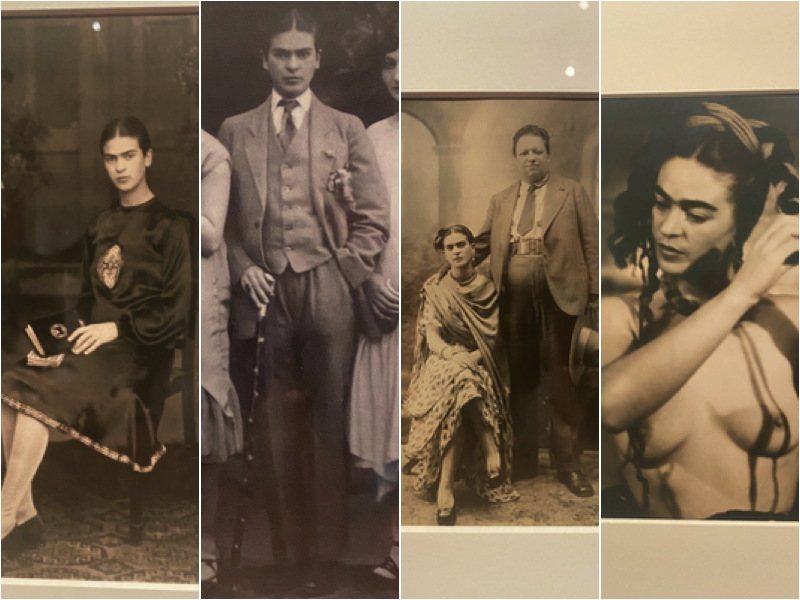
We began our tour in the room housing her very first self-portrait, the one she painted in 1926 as a gift for her boyfriend Carlos Arias, who was about to leave for Europe. She had been bedridden for over eight months after a tram collision that shattered her body when she was just eighteen years old. Before the accident, she had been an ambitious, mischievous medical student at one of Mexico’s most elite schools, running with a radical crowd of poets and writers. Confined to bed, she began to paint.
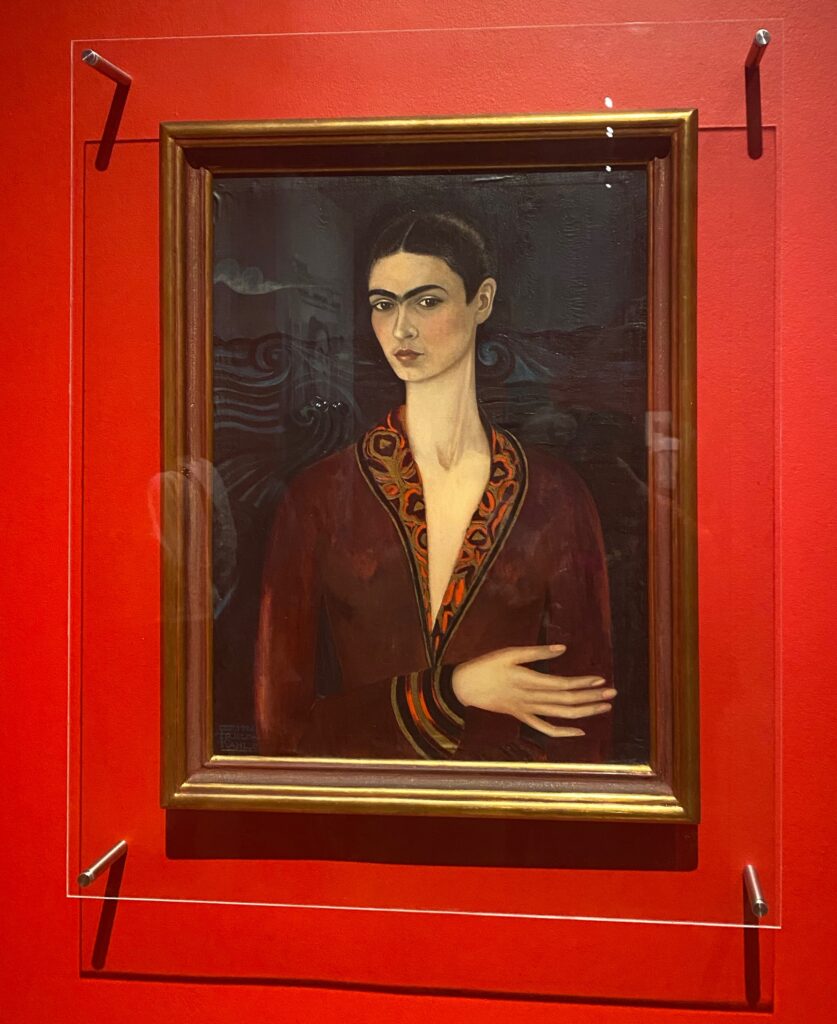
This first Self-Portrait (with Velvet Dress), shows her in a sumptuous velvet robe, low cut and sensual, her gaze already direct and unflinching. She is showing off her knowledge of European art, referencing Botticelli and Modigliani, presenting herself as an intellectual and an avant-garde painter. It is an astonishingly sophisticated work for a self-taught artist barely out of her teens, and it sets the template for everything that followed.
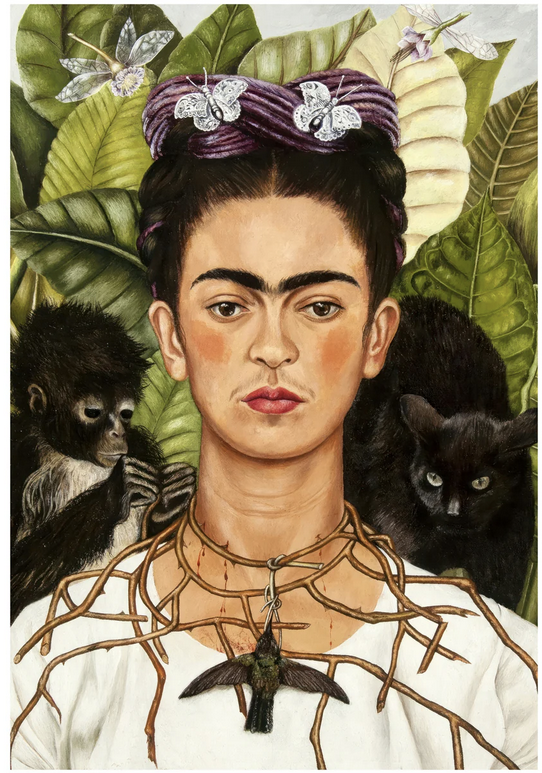
A few rooms later we stood before what is arguably her most iconic image, Self-Portrait with Thorn Necklace and Hummingbird from 1940, the very painting you will have seen plastered across London in the run up to this show. Frida faces us frontally, Christ-like, a crown of thorns around her neck from which a dead hummingbird hangs. A monkey, a gift from Diego, tugs at the thorns while a black cat crouches ready to pounce. Silver butterflies are pinned in her elaborate braided hair, and surrealist flowers float above her. It was painted in the year she divorced Diego, then remarried him, a time of intense emotional pain. She had declared she would never take money from a man again and was determined to earn her own living. The painting is raw with suffering, but it also crackles with strength. As the curator, Mari Carmen Ramírez of the Museum of Fine Arts in Houston, explained during our tour, the hummingbird references a Mexican folk tradition for winning back a lost love. The cat is poised, ready. Frida is never just a victim. She is always a fighter.
The direct gaze that changed everything
Ramírez made a point that really stayed with me. Frida painted over fifty self-portraits in her lifetime, and in nearly all of them she faces the viewer head on, eyes locked, unibrow unmistakable. She learned this direct engagement from her father, a photographer who specialised in self-portraiture and often used his daughter as a model. That frontal, unapologetic presentation is what makes encountering a Frida painting feel less like looking at a picture and more like being seen by it. She puts herself out there, entirely, and says this is me, this is my suffering, this is my reality. It is that rare quality that makes audiences cry in front of her work. Ramírez told us that at the exhibition’s previous stops, women regularly arrived dressed as Frida, some weeping with joy or sorrow at the mention of her name. There is an emotional connection here that is almost unique in modern art. You do not see people dressing up as Picasso.
The exhibition captures this phenomenon beautifully in a section devoted to artists who have chosen to embody Frida, to dress as her, to stage themselves as her. There is a glorious photograph of Tracey Emin done up as Frida.
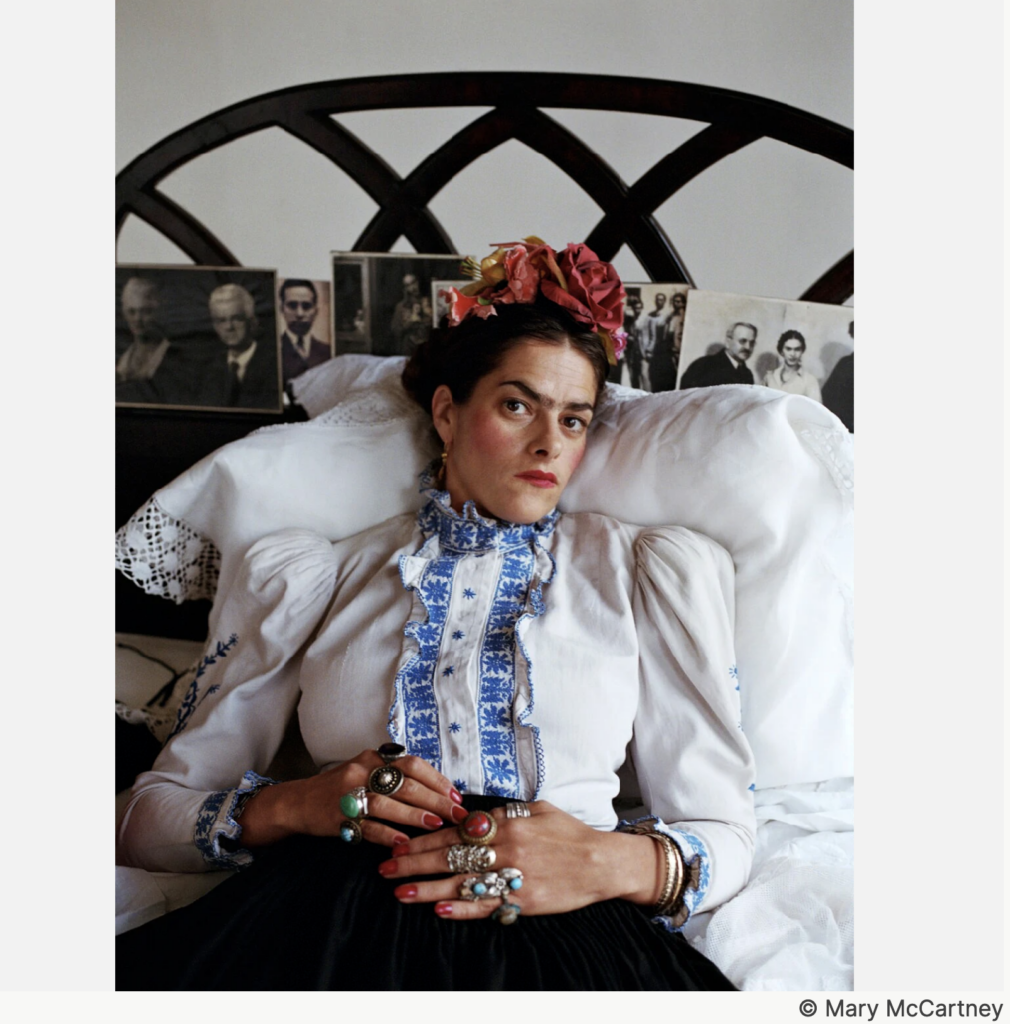
There is work by the Japanese artist Morimura, who transforms himself into her. There are Frida look-alikes from all over the world, and the point is clear: this is not mere imitation. It is a form of homage, a way of channelling her resilience and her refusal to be diminished.
The Chicano Altar and the birth of an Icon
One of the most moving moments of the entire exhibition, and the one that brought a lump to my throat, is the recreation of a 1978 altar, or ofrenda, dedicated to Frida. This was made by the artist Carmen Lomas Garza for a Day of the Dead (Dia de los Muertos) exhibition at Galería de la Raza in San Francisco, and it marks a pivotal moment in Frida’s rebirth. In the 1970s, decades after her death, a new generation of Chicano artists and activists, fresh from the Civil Rights Movement, travelled to Mexico, discovered her work and declared that she must become a role model for their community. They were the ones who established the visual conventions we now take for granted: Frida with brown skin, the unibrow and eyes isolated as an emblem, the idea of the artist placing herself beside Frida in a self-portrait. They turned her into a mestiza icon.
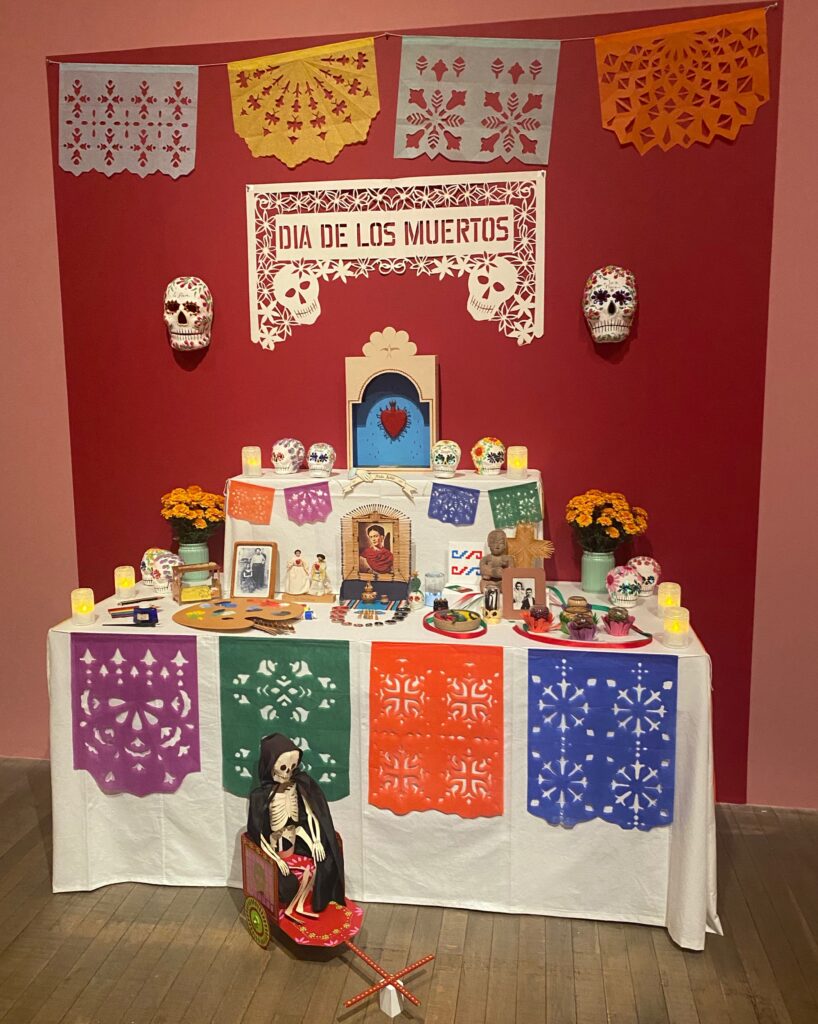
Carmen Lomas Garza herself was at the press view, and she spoke with such warmth about creating the altar. She filled it with marigold crepe paper flowers, jars of corn, beans, squash, amaranth, cacao and vanilla, all foods native to Mexico, along with water and art supplies so that Frida’s spirit could continue creating. At the very top of the altar she shaped Frida’s famous eyebrows into a bird, carrying her spirit upward. Standing in front of it, surrounded by the hum of the gallery, I felt genuinely overcome. Here was an artist giving thanks to another artist across time, welcoming her back to earth.
Pain, resilience and the body
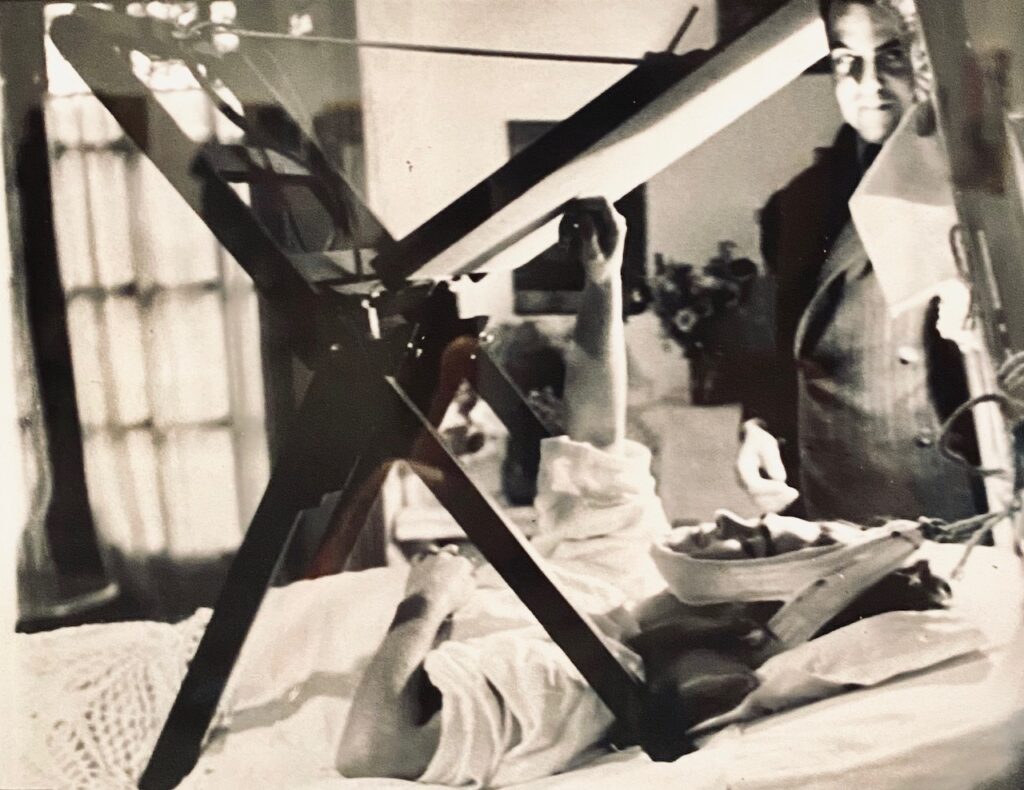
The exhibition does not shy away from Frida’s physical suffering, but it frames it as part of her incredible resilience rather than something that defines her only as a victim. One room displays some of the corsets she wore, revealed to the world only in 2003 when a sealed bathroom at the Casa Azul was opened after fifty years.
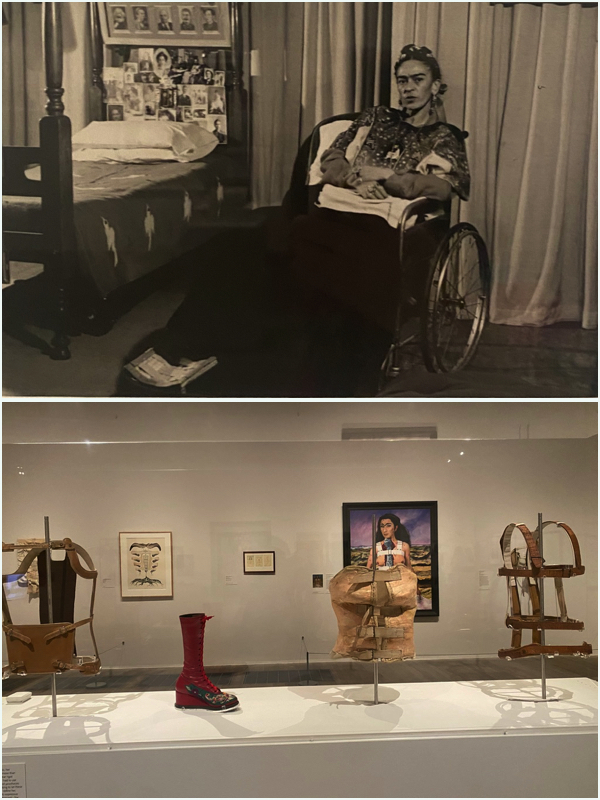
Painted and decorated, they are both medical devices and artworks in their own right. There is a stunning painting from 1951 dedicated to her doctor, towards the end of her life when her leg had been amputated and she was often in a wheelchair. The palette she holds is shaped like a heart, an offering of thanks.
Around the room, contemporary disabled artists respond to her legacy, referencing her famous painting The Broken Column, which shows her spine as a shattered Greek column, her body pierced with nails, tears on her cheeks, and yet her gaze remains steady. That refusal to look away from pain, to transform it into something fierce and beautiful, is what draws so many to her.
Fridamania, Barbie and the 100,000 Objects
And then, of course, there is the final room, the one that embraces the commercial explosion of Frida’s image with a knowing wink and a raised eyebrow. This is Frida-mania laid bare. The exhibition does not tut at the commodification of her face. Instead it examines it with curiosity, tracing the phenomenon back to the 1990 Mexico exhibition at the Metropolitan Museum in New York, where Frida became the marketing symbol for an entire festival of Mexican art.
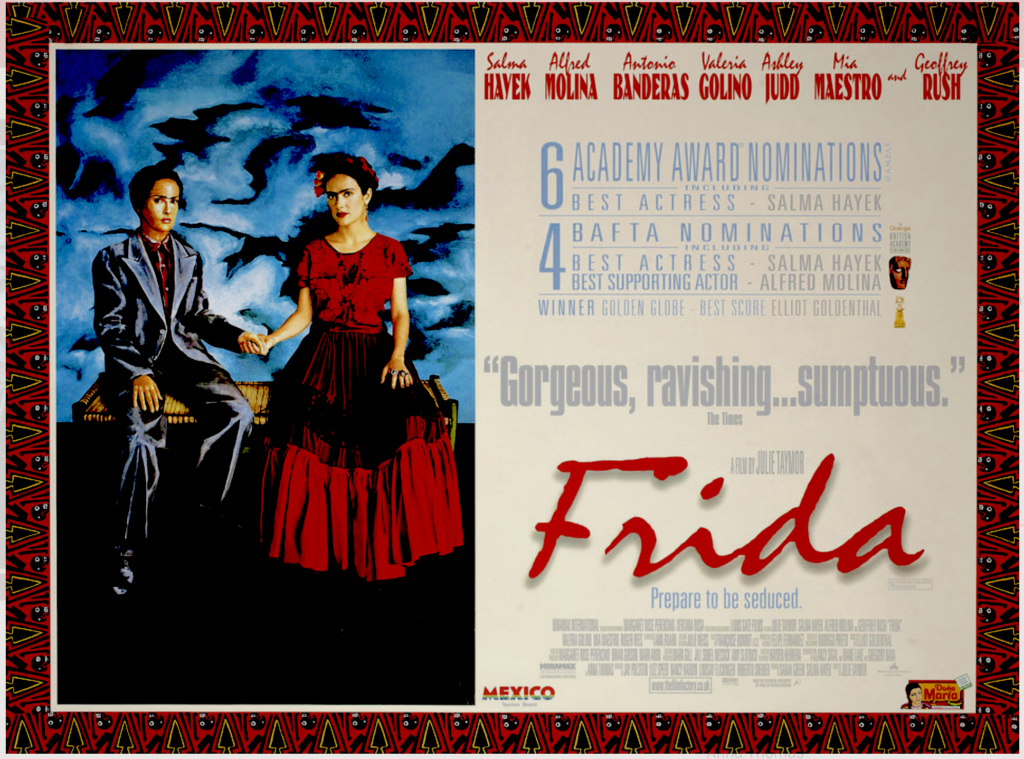
She appeared on billboards, buses, magazines. Critics noticed audiences were dressing like her. Then Madonna bought several of her works and introduced her to Hollywood, and then came Salma Hayek’s film, and the rest is history.
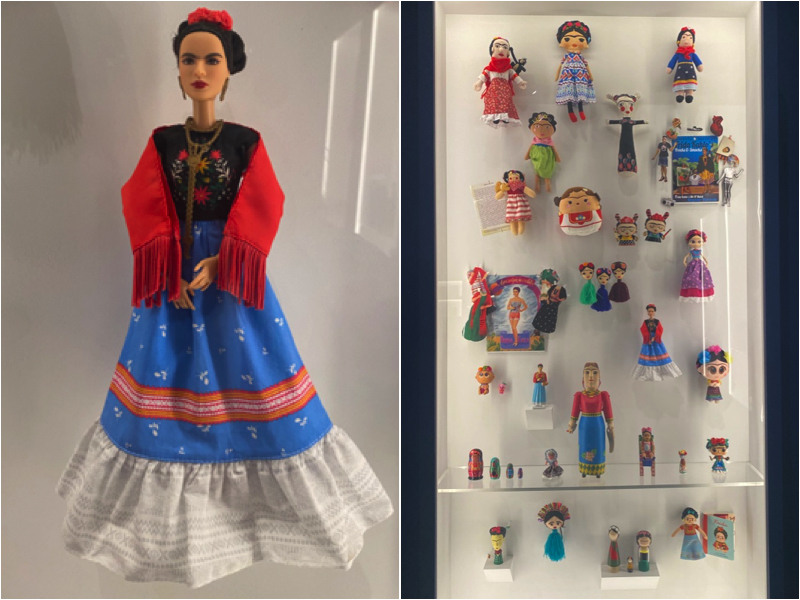
Now, as Ramírez pointed out, there are more than 100,000 objects bearing Frida’s face on Amazon and Etsy alone. The exhibition displays hundreds of them, from t-shirts and tote bags to, yes, sanitary napkins and egg holders. There is even a section on the infamous Frida Barbie doll, which was heavily criticised for smoothing away her unibrow, making her taller and whiter, and erasing her disability. It is a reminder that commodification always comes with a cost, that her image can be sanitised and simplified, but the exhibition argues that Frida endures anyway. She is too complex, too stubborn, too alive to be reduced to a logo.
The murals, the street and the city wide party
This refusal to stay put, to stay inside the gallery, is exactly what makes London’s summer of Frida so thrilling. As we emerged from the exhibition, blinking and overloaded, we headed off on a Frida mural trail and it was honestly one of the most joyful afternoons I have spent in this city.
Six enormous murals have been created by emerging artists aged under 25, all responding to different facets of Frida’s identity. They are part of a collaboration called Beyond Boundaries, organised by Tate Collective and Better Bankside, and they are genuinely stunning. Amy Almeida’s Paisajes Mexicanos on Sumner Street celebrates Frida’s homeland while also highlighting the environmental devastation of oil drilling. Eddie Donaldson’s Dining Table on Ewer Street uses collage to explore vulnerability and the negotiation of pain. Milena De Rosa’s Tea Break (Expanded) on Southwark Street is an intimate domestic scene with her mother, playing with Frida’s symbolic use of animals. Helena Samarasinghe’s Rooted in Play on Great Suffolk Street connects Mexican cultural presence with women’s football, a timely nod to this year’s World Cup. Gloria da Silva’s Long Live London on Great Guildford Street pays tribute to Frida’s final painting, Viva La Vida, through sign language, a joyful celebration of diversity. And Sharoola’s Here and Now on Green Dragon Court asks what makes a person who they are, drawing on Frida’s way of weaving personal experience into cultural history.
Each mural will remain in place for several years, so you have plenty of time to find them all. I made it my mission to track down every single one, my Frida dress billowing in the summer breeze, and I can confirm it is the most uplifting treasure hunt a family could embark on this season.
Over in Soho, Carnaby Street has been transformed into a spectacular installation called ¡Frida Icónica! Garlands of traditional Mexican papel picado, intricate paper cuttings designed by Mexican artist Alejandra Ballesteros, cascade overhead, while an anamorphic mural reveals Frida’s unmistakable profile when you view it from just the right spot. It is bold, colourful and entirely free, launching to coincide with both Pride month and the exhibition opening. Frida, who was proudly bisexual and lived her life with radical authenticity, would surely have adored the timing.
Even Piccadilly Circus is getting in on the act, with Frida’s self-portraits lighting up the famous screens at 8.30pm, and the Blackfriars mural, produced by JACK ARTS as part of BUILDHOLLYWOOD, is already a selfie magnet of the highest order.
Why SHE refuses to go away
Walking back along the South Bank as the afternoon light turned golden, I kept thinking about something Mari Carmen Ramírez said. She and her team thought the Frida phenomenon might have been exhausted by the end of the 1990s, that it was already a historical curiosity. But when they began researching, they discovered several more generations of artists still drawing inspiration from her, still finding fresh meaning in her work. Frida, she said, is the girl who refuses to go away. And she will not go away for a long time, because the issues she represents, social justice, equality, a fierce leaning towards a fairer world, are still present today and will be for a long time to come.
As a mum, I found myself thinking about what I want my son to take from this. Not just the bright colours and the dramatic story, though those are wonderful. I would like him to understand that you can build yourself, that you can take your pain and make something astonishing from it, that you can hold multiple identities and love fiercely and dress outrageously and never let the world shrink you. Frida Kahlo did all of that, and now, right here in London, we get to spend six whole months in her company. Go and see her. She has been waiting for you.
Need to know
Frida: The Making of an Icon runs from 25 June 2026 to 3 January 2027 at Tate Modern, Bankside, SE1 9TG. Open daily 10am to 6pm, and until 9pm every Friday and Saturday. Tickets are available at tate.org.uk or by calling 020 7887 8888. Entry is free for Tate Members. Given the record pre-sales, booking ahead is strongly advised.
The Beyond Boundaries murals are free to view across Bankside and will remain in place for several years. The Carnaby Street installation ¡Frida Icónica! runs from 25 June to September 2026. The Blackfriars mural and Piccadilly Lights activation are also free and open to all.
Dressing up as Frida is entirely optional but highly recommended.
Monica Costa founded London Mums in September 2006 after her son Diego’s birth together with a group of mothers who felt the need of meeting up regularly to share the challenges and joys of motherhood in metropolitan and multicultural London. London Mums is the FREE and independent peer support group for mums and mumpreneurs based in London https://www.londonmumsmagazine.com and you can connect on Twitter @londonmums
