

Settling into life in the UK can be an exciting time, which also comes with plenty of practical tasks. Beyond arranging schools, work or housing, one detail you cannot overlook is proving your immigration status. In certain circumstances such as renting a new home or opening a bank account, you’ll be asked to provide evidence of your right to reside in the country. This guide sets out what you need to know so the process feels less daunting and more straightforward.
Here, Gemma Tracey, a Partner specialising in immigration law at JMW Solicitors, explores how you can prove your immigration status in the UK.
Understanding immigration status in the UK
Your immigration status defines what you can do while living here, including things like working, studying and using public services. While each person’s circumstances are different, the most common categories include:
- Indefinite Leave to Remain (ILR) or settled status: granted to those who have lived in the UK for a qualifying period and successfully applied for ILR, allowing permanent residence without restrictions.
- Pre-settled status: for EU, EEA and Swiss nationals, and their families, who have not yet reached five years of continuous residence. It allows temporary residency until they can apply for settled status.
- Permission to stay: for those who have a visa to be in the UK for a certain period of time. For example, for work, student and family visas, each route has its own conditions. For example, a Skilled Worker visa ties you to a sponsoring employer, while a Student visa permits study and may allow part-time work.
- Refugee status: protection for those recognised under the 1951 Refugee Convention, giving the right to work and access to public services.
- Humanitarian protection: for people facing serious harm if returned to their home country but who do not meet the definition of a refugee.
Proving your immigration status
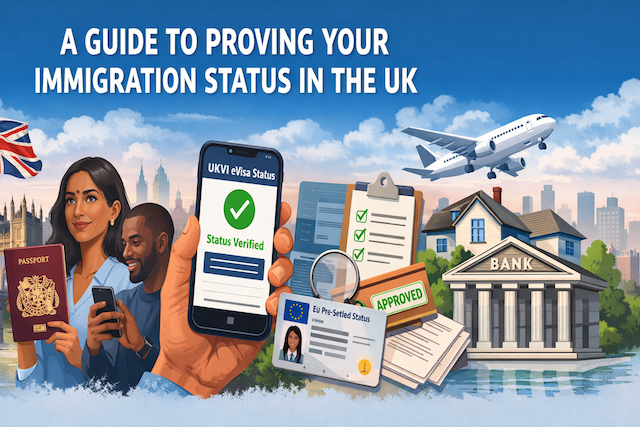
The UK is moving towards a digital immigration system, which means most people now prove their status using an electronic visa (eVisa). While paper documents such as passport vignettes or Biometric Residence Permits (BRPs) were once standard, the Home Office is phasing these out.
Expired BRPs or Biometric Residence Cards were accepted for travel to the UK only up to 1?June?2025. Beyond that date, an eVisa must be used for travel. Many forms of permission to enter the UK are now being granted digitally, too.
To use an eVisa, log in to your UK Visas and Immigration (UKVI) account using your identity document, date of birth and contact details linked to your application. You can then generate a share code whenever proof is required.
This process only takes a few minutes and means that your status can be verified without relying on physical documents.
Tips for using the digital system
Using the UKVI portal can be straightforward if you prepare ahead. The following points can help:
- Keep your details current: if you change your passport, email address or phone number, update your UKVI account immediately so your eVisa is linked to the correct information.
- Check before travelling: make sure the passport you travel on is connected to your eVisa, otherwise, carriers may not be able to verify your status.
- Seek digital support: if you are not comfortable using online platforms, immigration community groups and charities often provide practical help.
- Carry backup evidence when travelling: such as your visa decision letter, in case of system outages or delays.
These steps reduce the likelihood of disruption when working, renting or travelling.
Common issues and how to handle them
Even with a digital system, challenges sometimes occur. Below are common problems and practical ways to address them:
- Technical errors: if the online service is unavailable, wait and try again, or contact the Home Office helpline.
- Requests for physical proof: if an employer or landlord insists on documents, explain that the digital check is the official legal method and provide a fresh share code.
- Expiring visas: always apply to extend your permission before its expiry date to avoid problems accessing services.
- Accessing healthcare: occasionally, GP surgeries ask for immigration documents or proof of address when registering new patients. If this happens, you can point out that NHS guidance allows everyone to register with a GP regardless of immigration status, and practices should not refuse registration if you do not have ID or paperwork.
By knowing how to respond, you can resolve issues more quickly and minimise stress.
If your status is questioned
It can be unsettling if an organisation challenges your right to be in the UK, but there are practical steps you can take. These include:
- Keeping records of your communications, including emails or documents you have shared.
- Saving copies of your eVisa or decision emails in case you need them as evidence.
- Remaining calm and offering clarification if the person checking your status is unfamiliar with the process.
- Seeking help from the UKVI helpline, migrant support organisations or professional immigration solicitors if problems persist.
Taking these steps can help you resolve disputes and maintain access to work, housing and services.
What to do if your ILR is in an old passport
If you hold ILR in an old passport or legacy document, it won’t be possible for you to access an eVisa straight away. You would need to make a No Time Limit (NTL) application to confirm your status and enrol your biometrics. Once this has been approved, you will be able to access your eVisa, which would be linked to your current passport.
Many individuals find it useful to have support from an immigration lawyer with this process, as requesting information from the Home Office, reviewing supporting documents, and ensuring that ILR has not lapsed, helps to support an application.
Applying to naturalise as a British citizen
Many individuals with ILR opt to apply to naturalise as a British citizen. ILR can be lost if a person is outside the UK continuously for two or five years (depending on their ILR status), unlike British citizenship, which is granted for life. Travelling overseas can be made simpler with British citizenship, as you would enter the UK with your passport and would no longer need an eVisa to enter the UK.
There are a number of requirements for a naturalisation application, and an immigration lawyer can help to support you with an application.
Staying informed and supported
The transition to digital immigration status is a major shift, and preparation can make it easier. By setting up your UKVI account, keeping your details updated and knowing how to generate and share codes, you will be better equipped to handle the situations where proof is needed. Support from official channels and legal professionals is always available if you require further assistance.
Contact JMW Solicitors’ expert immigration team to see how we can assist you with applications for permission to stay in the UK, NTL applications, or applications to naturalise as a British citizen.

Monica Costa founded London Mums in September 2006 after her son Diego’s birth together with a group of mothers who felt the need of meeting up regularly to share the challenges and joys of motherhood in metropolitan and multicultural London. London Mums is the FREE and independent peer support group for mums and mumpreneurs based in London https://www.londonmumsmagazine.com and you can connect on Twitter @londonmums
