

Let me paint you a picture. There I was, standing in the shadow of Battersea Power Station – that magnificent brick cathedral of Art Deco industry immortalised by Pink Floyd in their iconic album – about to walk into an exhibition featuring treasures from the time when my beloved Italy was still just a collection of hills with some very confused tribes wandering about. And the best part? I had a press pass that felt like Willy Wonka’s golden ticket.
London Mums were amongst the very first to walk through the doors of Ramses and the Pharaohs’ Gold, and honestly? My brain is still processing what my eyes saw.
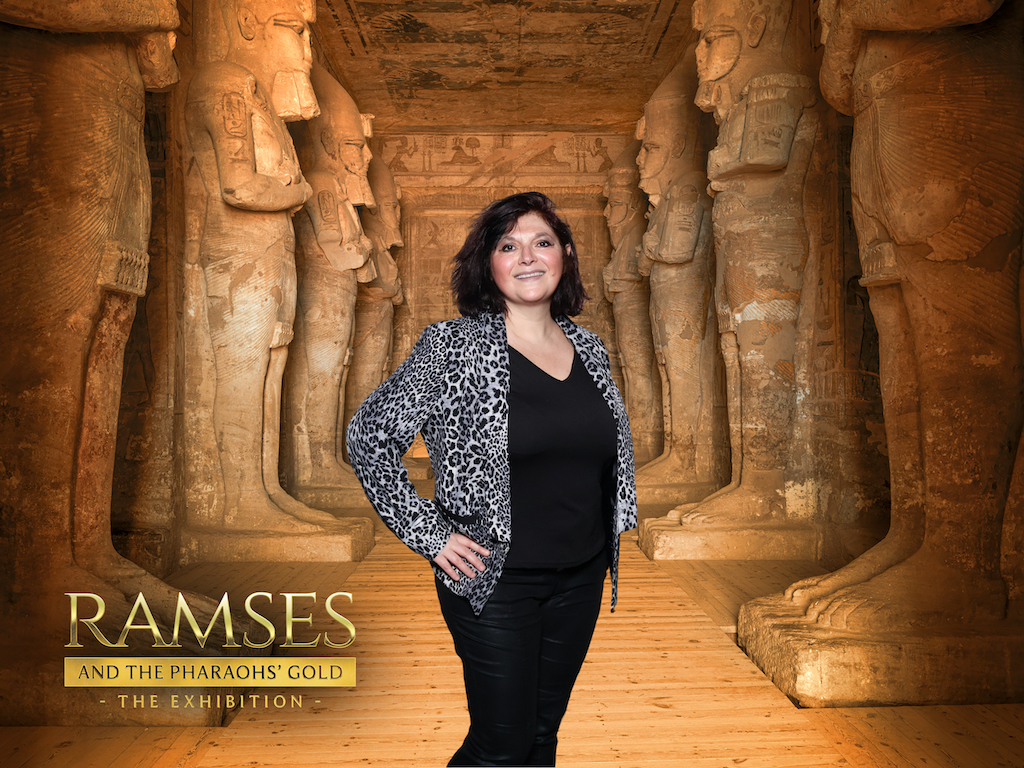
First impressions: This is not a replica situation
Right, let’s get something straight from the outset. When exhibitions promise “priceless artefacts,” you brace yourself for a few dusty bits of pottery and maybe a shabti or two behind glass. You do NOT expect to come face-to-face with objects so perfectly preserved they look like they were made last Tuesday by a very talented Etsy seller. But here we are.
The exhibition brings together 180 priceless artefacts on loan from the Grand Egyptian Museum in Cairo, many of which have never before been seen in the UK. We’re not talking replicas. We’re not talking “inspired by.” We’re talking the real deal – gold that actually touched the skin of pharaohs, jewellery that adorned royalty, and the actual coffin where Ramses II himself was laid to rest.
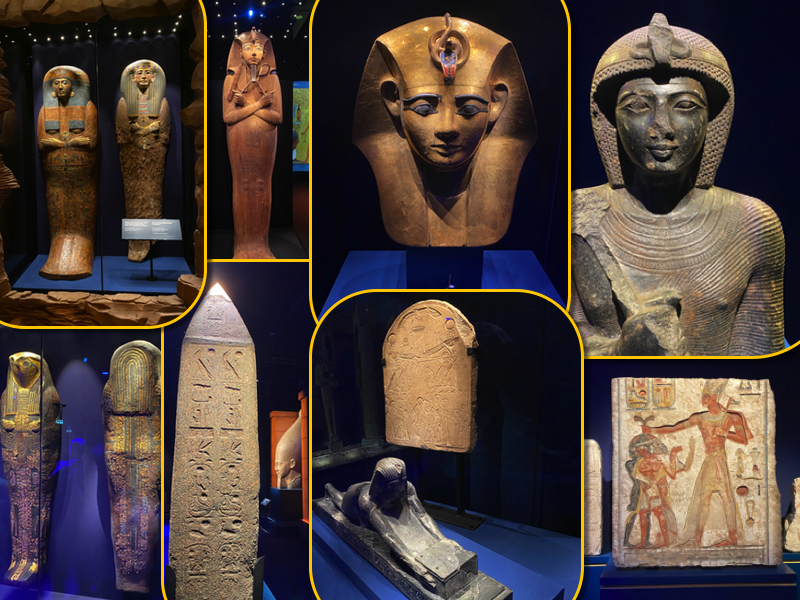
The man who ruled Egypt for nearly 67 years, who lived for 90 years, who fathered over 100 children (imagine that school run), who had statues of himself erected everywhere because subtlety wasn’t really his thing – his coffin is in Battersea!
The “wait, this is REAL?” moment
The first room hits you like a sandstorm. There are colossal stone heads, beautifully carved, staring at you with that trademark Egyptian serenity. I immediately started playing “who can make the funniest face back at them,” which felt slightly disrespectful but also very me.
But it’s when you get to the jewellery that things get properly ridiculous.
The gold necklaces. The bracelets. The rings. The earrings.
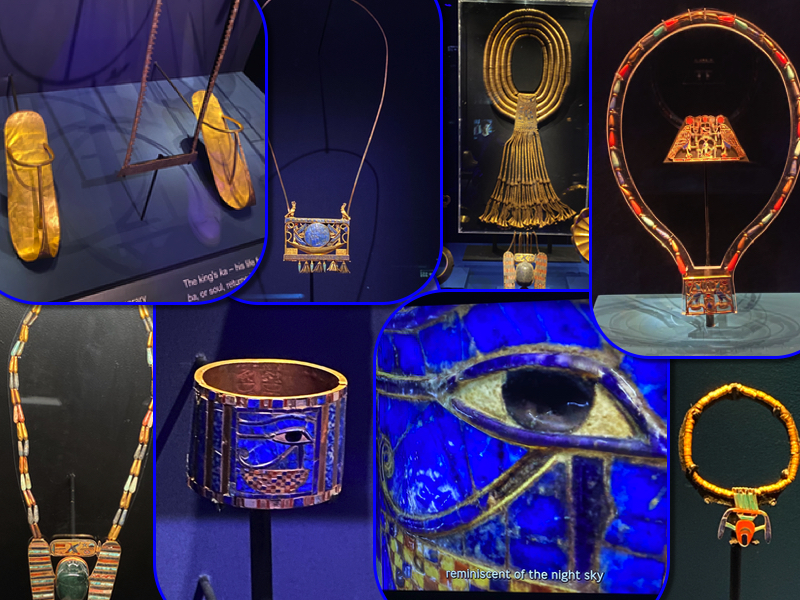
They’re so shiny, so impossibly well-preserved, that I genuinely caught myself wondering if someone had snuck in a few pieces from Ratners by mistake. Nope. All 3,000+ years old. The gold from the tombs of Tanis – including the funerary mask of King Amenemope – gleams like it was polished this morning. If I’d worn one of those necklaces out of the exhibition, it would have matched my Zara outfit perfectly.
(I should clarify: I did not steal any ancient Egyptian jewellery. The security was very thorough.)
The star of the show: Ramses’ Coffin
Here’s the thing that kept bothering me, though. The exhibition features the actual coffin of Ramses II – the wooden sarcophagus that held the body of Egypt’s greatest pharaoh. It’s extraordinary to see. The craftsmanship, the detail, the sheer presence of it.
But it did get me wondering: if the coffin is here in London, where exactly is Ramses right now?
Is his mummified body just… hanging out in Cairo, wondering where its bed went? Is there a very confused museum curator in Egypt with a spare pharaoh and nowhere to put him? These are the questions that keep me up at night.
(For the record, the mummy remains in Egypt. The coffin is on tour. Ramses is apparently fine with this arrangement.)
The personal touch: My name in Hieroglyphs
Now, here’s where the exhibition really won me over. As part of the press preview, we were treated to something genuinely special: a beautiful piece of Egyptian papyrus – a pergamena, if we’re being fancy – with mine and my son Diego’s names written in authentic hieroglyphics.
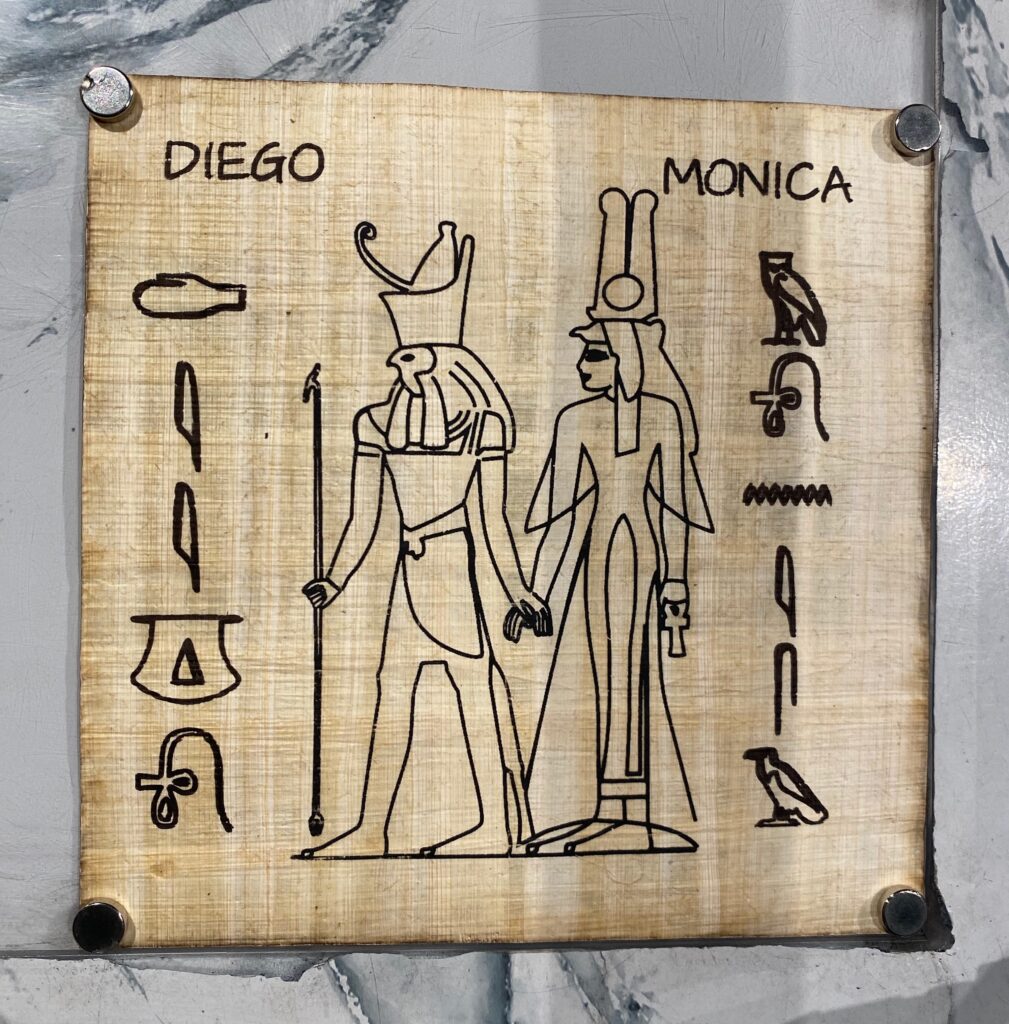
Diego, translated into ancient Egyptian symbols, looks somehow more dignified than it does on the school register. And my name, Monica, rendered in the language of the pharaohs? I’m considering having it framed and replacing my family photos with it. Sorry, family. You had a good run, but ancient Egyptian Monica has arrived.
It’s the kind of keepsake that makes the exhibition feel personal. These weren’t just distant historical figures – they were people who had names, just like us. And now Diego has proof that his name exists in a 3,000-year-old writing system. Try doing that with a crayon.
The VR Experience: I went to Egypt and all I got was this virtual headset
Okay, I need to talk about the virtual reality experience because it genuinely took my breath away.
You put on the headset, and suddenly you’re not in Battersea anymore. You’re standing in the beautifully decorated tombs of Ramses II and his beloved queen Nefertari. The colours on the walls are so vivid, so impossibly bright, that you forget you’re looking at something that’s been underground for millennia.
You can look around, move through the spaces, and get a genuine sense of what it would have felt like to be an ancient Egyptian – minus the whole “waiting to be mummified” anxiety.
I am usually harder to impress than a TikTok influencer at a brand event, but I was genuinely gobsmacked. I was inside the tomb!
The VR is recommended for ages 8 and above, and I’d say that’s about right. Any younger and they might find the headset heavy or the experience a bit intense and possibly scary. I screamed at some point… No spoilers, though. But for families with older kids? It’s an absolute must-do.
For the Kids: Scavenger Hunt Energy
If you’ve got little ones (recommended age is 5+), this exhibition is brilliantly set up for them. There’s an inherent scavenger-hunt quality to the whole thing – spot the animal mummies, find the biggest gold necklace, count how many statues have broken noses (answer: a lot, thanks to centuries of tomb raiders and enthusiastic Europeans).
During the visit I went from case to case with the enthusiasm of a very wise Egyptologist. The animal mummies were a particular hit: cats, birds, even crocodiles, all preserved and wrapped and looking surprisingly peaceful for creatures that were sacrificed to the gods.
There’s something deeply reassuring about watching children connect with history across thirty centuries. The details change: we have iPads, they had hieroglyphs – but the wonder? That stays the same.
The catalogue: A book that could double as a weapon
Before I left, I was gifted the exhibition catalogue.
This thing is not messing about.
It’s a huge, heavy book – the kind you’d use to prop open a door, or defend yourself in a crisis, or simply display on your coffee table to make visitors think you’re incredibly sophisticated. It’s packed with high-resolution images of every artefact, plus detailed explanations of their significance.
I genuinely don’t know where I’m going to put it. But I know I’ll treasure it. Every time I look through those pages, I’ll remember standing in front of those objects, marvelling that something so old could feel so present.
Practical Information (Because You’re Going to Want to Go)
The exhibition is now open at NEON at Battersea Power Station, and you can book tickets through until May 31st. Here’s what you need to know:
Location: 2 Circus Road East, SW11 8DQ (Battersea Power Station tube is Zone 1 and about 15 minutes from the West End – easy peasy)
Duration: Allow 60-75 minutes for the main exhibition, plus extra time for the VR experience.
Opening hours:
- Sunday-Thursday: 10am-4pm
- Friday: 10am-6pm
- Saturday: 9am-6pm
Age recommendation: 5+ for the main exhibition, 8+ for VR
Accessibility: The venue is wheelchair accessible
Bag policy: Anything larger than A4 won’t be permitted, so travel light
Headphones: If you want the audio guide (narrated by historian Dan Snow, and excellent), bring your own headphones
The ticket bundles: Go for the Gold
If you’re booking (and you should), consider splashing out on one of the experience bundles:
- The Pharaohs’ Bronze: Exhibition entry + audio guide + tea/coffee and cake
- The Pharaohs’ Silver: All of the above + souvenir brochure + digital photo + skip-the-queue access
- The Pharaohs’ Gold: The full works – skip-the-queue entry, guided tour, VR experience, exhibition catalogue, digital photo, limited edition Egyptian collectible, AND your name printed in authentic hieroglyphics on papyrus, plus tea/coffee and cake.
We experienced the Gold treatment, and I have to say – having your name in hieroglyphs is the kind of flex that stays with you. Diego has already informed me that he’ll be using his as evidence of his royal lineage. I’m not going to argue with him.
The Mum Verdict
Look, I’ll be honest. I’ve been to a lot of exhibitions. Some are good. Some are fine. Some you forget before you’ve even left the gift shop.
This one is different.
Ramses and the Pharaohs’ Gold isn’t just an exhibition – it’s a time machine. It’s a chance to stand in the presence of objects that were old when Cleopatra was a glint in her father’s eye. It’s an opportunity to show your children that history isn’t just words in a textbook; it’s gold and stone and wood, lovingly crafted by human hands thousands of years ago, still here, still beautiful, still telling their stories.
I haven’t stopped thinking about it.
And somewhere in Cairo, Ramses II’s mummy is waiting for its coffin to come home. But for now, it’s here. In Battersea. Waiting for you.
Go. Seriously. Go.
*Tickets are on sale now at ramsestheexhibition.co.uk/london. We were guests of the exhibition, but all opinions – and all wonder at 3,000-year-old bling – are entirely our own.*
You might also enjoy:

Monica Costa founded London Mums in September 2006 after her son Diego’s birth together with a group of mothers who felt the need of meeting up regularly to share the challenges and joys of motherhood in metropolitan and multicultural London. London Mums is the FREE and independent peer support group for mums and mumpreneurs based in London https://www.londonmumsmagazine.com and you can connect on Twitter @londonmums
