

Something has changed in exam halls across England, and it has happened without much comment. This summer, 492,330 GCSE entries came from students in year 12 or above. Four years ago that figure was 313,210. In other words, entries from people who have already finished year 11 have grown by more than half in four years, and they now account for roughly one in twelve of all GCSE entries in the country.
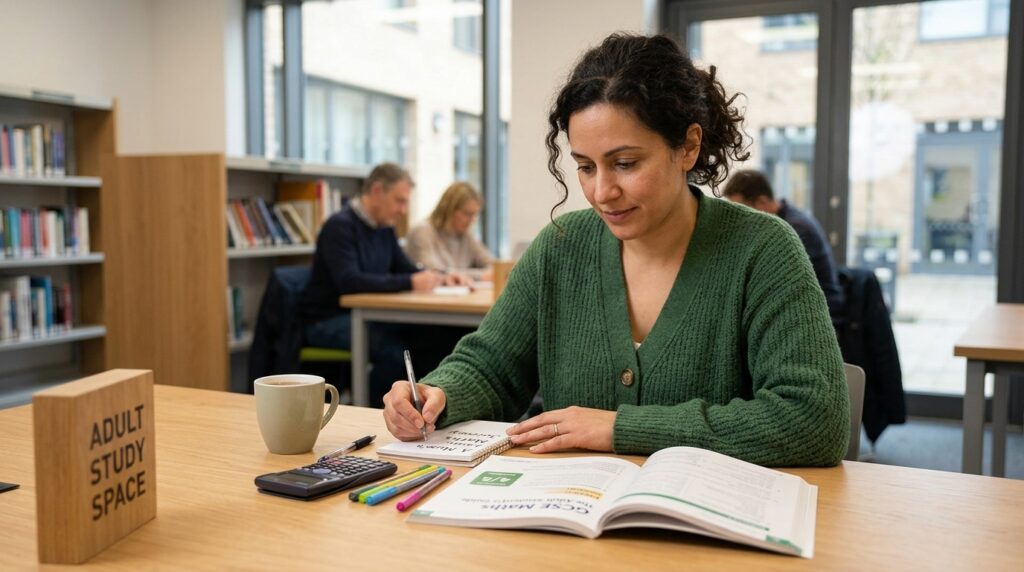
Maths is where the shift shows most clearly. Of the 876,955 GCSE maths entries submitted for summer 2026, 27.1% came from candidates in year 12 or above. More than one in four people sitting GCSE maths this year had already sat it, or should have, at school.
These are not children. Many are seventeen and eighteen year olds in college, required to keep studying maths because they did not reach a grade 4 first time. A growing number are considerably older, and they are there by choice.
Why so many adults end up back in front of a maths paper
The reason is almost always a door that will not open. Nursing degrees ask for GCSE maths. Initial teacher training in England requires a grade 4 in both maths and English, with a science GCSE on top for primary. Social work, midwifery, paramedic science, the police and a long list of apprenticeship standards all set the same bar. So does a surprising amount of promotion inside organisations that never mention it in the job advert until you apply.
People rarely discover this at eighteen. They discover it at twenty-nine, halfway through an application form for a career they have already decided on, and then they have to go back and fix something they last thought about in a school hall a decade earlier.
The finding nobody expects
Here is the part that should encourage anyone in that position. In summer 2025, 17.1% of candidates aged seventeen and over achieved a grade 4 or above in GCSE maths. That figure gets quoted a lot, usually to make a point about how hard resitting is.
Break it down by age and it tells a different story. Among candidates aged seventeen to nineteen, 15.3% reached a grade 4. Among candidates aged twenty and over, 34.0% did. Adults passed at more than double the rate of the teenagers sitting the same paper. The pattern repeats in English: 19.7% against 33.2%.
The data does not explain why, and it would be wrong to pretend otherwise. These are different groups in different situations. But the difference is large, consistent across both subjects, and worth knowing if you are an adult who has been told that resit pass rates are dismal. The dismal number is mostly describing somebody else.
The obvious explanation is motivation. A seventeen year old in college is studying maths because the funding rules say their institution must make them. From 2026/27 those rules specify a minimum of 100 hours of teaching a year in each of maths and English for full-time students without a grade 4. A thirty-four year old who has paid for a course and booked an exam is doing it because they want a specific job, and they have worked out precisely what it will cost them not to have the qualification.
What actually gets in the way
Talk to adults who have done this and the maths is rarely the obstacle they describe. Three other things come up far more often.
The first is time. Providers recommend between 120 and 200 hours of study per GCSE. Spread across nine months that is around four hours a week, which is manageable around shifts and childcare. Compressed into three months it is not, and people routinely underestimate this and then give up feeling like they failed at algebra.
The second is that adult maths anxiety is real and specific. Most people returning to the subject are not starting from zero. They are starting from a decade of quietly believing they cannot do it, usually formed in a classroom where they fell behind in week three and never caught up. Working through material at your own pace, with the ability to go back over a topic without an audience, addresses that far better than sitting in a room with thirty other people.
The third is administrative and it catches almost everyone. As a private candidate you have to find an exam centre that accepts external entries, confirm it offers your exact specification and book roughly six months ahead. Centres prioritise their own students and cap external numbers. This is why some people choose to study GCSE maths online with a provider that arranges the exam entry as part of the course, rather than discovering in February that nowhere within fifty miles has a seat left in May.
Worth checking before you pay for anything
If you are nineteen or over in England and do not hold a grade 4 or equivalent in maths or English, government funding may cover you to study those subjects free at a further education college. Essential skills provision runs up to level 2, which is the grade 4 standard, and the college acts as its own exam centre so entry is handled for you.
It runs on a college timetable across an academic year and requires attendance, which rules it out for a lot of people working shifts or managing caring responsibilities. But it costs nothing, and it is worth ruling in or out before paying for an alternative. The funding does not extend past English and maths, so anyone needing a science or a language will be paying either way.
The tier decision people get wrong
GCSE maths is sat at one of two tiers, and the choice is made months before the exam. Foundation tier covers grades 1 to 5. Higher tier covers grades 4 to 9, with a narrow allowance at grade 3 for candidates who fall just short.
Since a grade 4 is what most employers and courses require, and Foundation reaches grade 5, Foundation is sufficient for the overwhelming majority of adults doing this. Yet people routinely enter Higher because it sounds like the serious option, then spend months on material that will never appear on a paper they need to pass, and sit an exam where the accessible marks are a smaller share of the total.
There are good reasons to take Higher. A-level maths, most science A-levels and some engineering routes want a grade 6 or 7, which Foundation cannot deliver. If you need a grade 4 for a nursing application, it almost certainly does not apply to you. Check what the thing you are aiming for actually asks for, in writing, before deciding.
The timeline that matters
Exams run to a fixed calendar and everything else works backwards from it. The main series sits in May and June, with results in August. There is a November series for maths and English specifically, with results in January.
Working back from a May exam, that means booking a centre by roughly the previous autumn and starting the course before that. Anyone deciding in January that they will sit maths in May is usually looking at November instead, which is not a setback so much as a fact about how exam timetables work.
Nearly half a million post-16 GCSE entries went in this summer. Whatever else that number says about the school system, it means that anyone going back to fix a maths grade at thirty is doing something entirely ordinary, alongside a great many other people who are simply not talking about it.

Monica Costa founded London Mums in September 2006 after her son Diego’s birth together with a group of mothers who felt the need of meeting up regularly to share the challenges and joys of motherhood in metropolitan and multicultural London. London Mums is the FREE and independent peer support group for mums and mumpreneurs based in London https://www.londonmumsmagazine.com and you can connect on Twitter @londonmums
