

The Easter holidays are here, and if you’re looking for something to do that doesn’t involve chocolate comas or another trip to soft play, we’ve got you covered. The Royal Society of Chemistry has shared five wonderfully messy experiments that turn your kitchen into a mini-lab – and sneak a bit of learning into the fun.
We’re talking swirling milk rainbows, hidden messages on eggs, and even a bouncy “rubber egg” that will make your children’s eyes pop. The best part? You probably already have most of the ingredients in your cupboards.
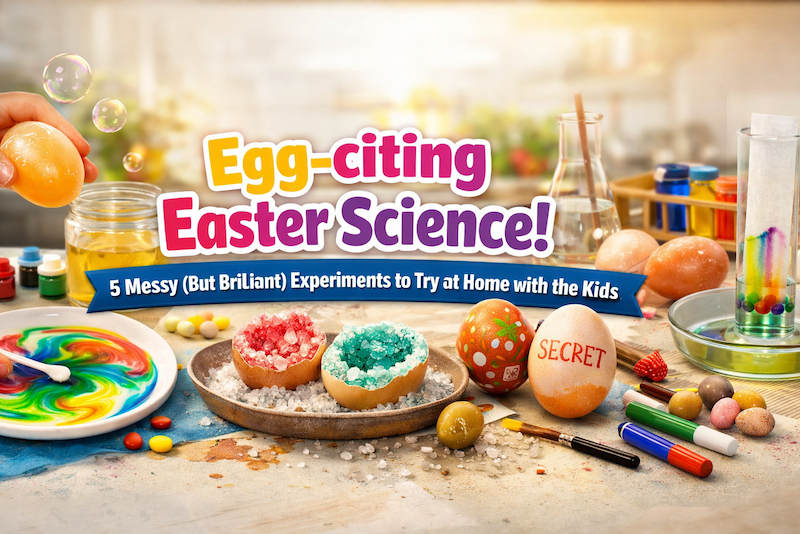
Ross Christodoulou, Education Coordinator at the RSC, sums it up perfectly: “Easter is the perfect time to let curiosity hatch. These simple experiments turn everyday ingredients into little bursts of chemistry fun: from swirling colours to sparkling crystals. You don’t need a lab coat to explore science with your family; just a sense of play and a willingness to get a bit messy!”
So, roll up your sleeves, protect the table (we recommend a wipe?clean cover), and let’s get experimenting.
1. Make art from milk
Discover the science behind colour by creating dramatic, colourful swirls in milk.
You’ll need:
- A shallow dish
- Whole milk
- Food colouring
- Washing?up liquid
- Cotton buds
How to do it:
- Pour enough milk into the dish to cover the bottom.
- Add a few drops of different food colourings around the milk.
- Dip a cotton bud into washing?up liquid.
- Touch the surface of the milk with the soapy bud and watch the colours swirl.
- Try it in different spots to create new patterns.
The science bit:
Milk contains proteins and fat droplets suspended in water. Soap molecules attach to fats and disrupt their structure. As the soap spreads, it pushes the surrounding liquid – and the food colouring – causing the dramatic swirling motion.
2. Make your eggs shine
Learn about natural mineral formation by growing your own “crystal eggs”.
You’ll need:
- Clean, empty eggshell halves or small jars
- Table salt or Epsom salts
- Warm water
- A spoon
- Food colouring (optional)
How to do it:
- Fill a cup with warm water.
- Add salt, one spoonful at a time, stirring continuously until no more dissolves – this is a saturated solution.
- Add a drop of food colouring if you want coloured crystals.
- Pour the solution into the eggshell halves or jars.
- Leave undisturbed for 12–48 hours, then watch sparkling crystals form.
The science bit:
Warm water can dissolve more salt than cold water. As the solution cools and gradually evaporates, it becomes too concentrated to hold all the dissolved salt. The excess salt molecules bond together in repeating geometric patterns – forming crystals, just like in caves and rocks.
3. Leave hidden messages on your eggs
Inspire curiosity about acidic reactions by dyeing eggs with a secret message.
You’ll need:
- Hard-boiled eggs
- Lemon juice
- Cotton buds or a fine paintbrush
- Food colouring or natural dyes
- A cup of warm water
How to do it:
- Dip a cotton bud into lemon juice.
- Write or draw on the eggshell with the lemon juice.
- Allow the egg to dry completely.
- Prepare a cup of dye (food colouring in warm water).
- Submerge the egg for a few minutes.
- Lift it out to reveal your hidden design – it will appear lighter than the surrounding shell.
The science bit:
Eggshells are made largely of calcium carbonate. Lemon juice contains citric acid, which gently reacts with and etches the shell. When the egg is dyed, the etched areas absorb less pigment, revealing the pattern. It’s a mild version of the acid?carbonate reaction that makes fizzing when acids meet bicarbonate of soda.
4. Hatch a “rubber egg”
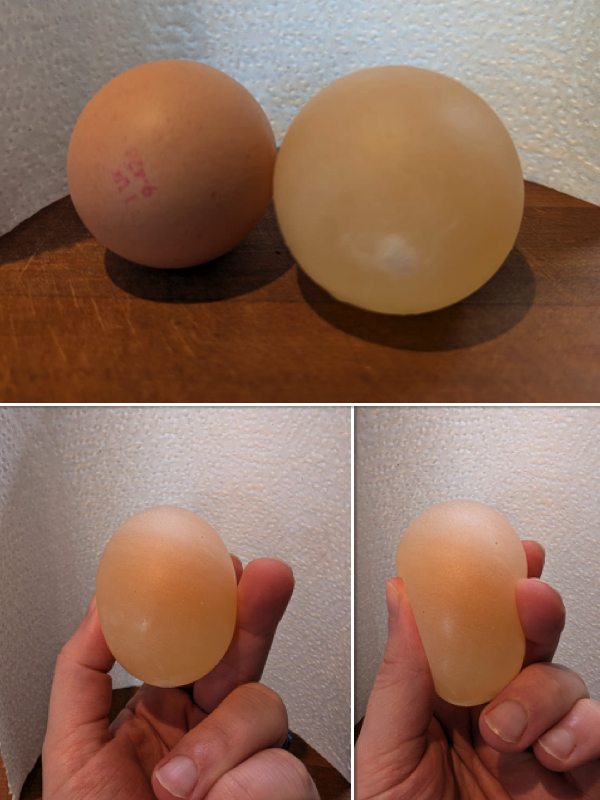
See osmosis in action by making a bouncy, stretchy egg.
You’ll need:
- A raw egg
- A glass or jar
- Vinegar
How to do it:
- Place the raw egg carefully into the glass.
- Cover it completely with vinegar.
- Leave for 24–48 hours. You’ll see bubbles forming on the shell.
- After a day or two, gently rinse the egg under water. The shell will have dissolved, leaving a bouncy, stretchy egg.
The science bit:
Vinegar contains acetic acid, which reacts with calcium carbonate in the eggshell to produce carbon dioxide gas (the bubbles). This dissolves the shell entirely. The inner membrane remains intact and is semi?permeable, allowing water to move into the egg – causing it to swell. That’s osmosis in action.
5. Watch your mini eggs leave a colourful trail
Separate mixtures using chromatography – a method used in real labs every day.
You’ll need:
- Mini eggs, Smarties or similar coloured sweets
- Filter paper, coffee filters or kitchen roll
- A plate or tray
- Water
- Small bowls or lids
How to do it:
- Cut a strip of filter paper or coffee filter.
- Place the bottom edge of the paper into a shallow pool of water (use a lid or small dish).
- Place a sweet so that its shell just touches the damp paper.
- As the water climbs the paper, it dissolves the dye from the sweet and carries it upward.
- Watch as the colours separate into different bands.
The science bit:
This is chromatography. Water travels up the paper by capillary action. Food colourings each have different molecular properties – some move more easily with water, others stick more to the paper fibres. As the water moves, these differences cause the colours to spread out and separate, revealing the individual dyes that made the original coating.
A few safety notes before you start:
- Adult supervision is recommended for all activities.
- Don’t eat any of the materials after they’ve been used in experiments.
- The “rubber egg” is not edible.
- Protect surfaces and clothing from dyes and spills.
- Dispose of eggs and solutions responsibly.
Happy experimenting – and if your kitchen ends up looking like a rainbow explosion, consider it a successful afternoon.
For more science fun, visit the Royal Society of Chemistry at www.rsc.org.

Monica Costa founded London Mums in September 2006 after her son Diego’s birth together with a group of mothers who felt the need of meeting up regularly to share the challenges and joys of motherhood in metropolitan and multicultural London. London Mums is the FREE and independent peer support group for mums and mumpreneurs based in London https://www.londonmumsmagazine.com and you can connect on Twitter @londonmums
