

New research reveals the hidden conversation between your gut and brain – and how to make it work for you.
You’ve had another broken night. You wake up groggy, snap at the kids over breakfast, and spend the morning hunting for the coffee pot like it’s the Holy Grail. By midday, you’re bloated, distracted, and wondering why you feel so… off.
Sound familiar? According to new research, the culprit might not be your busy schedule or your toddler’s sleep regression. It could be your gut.
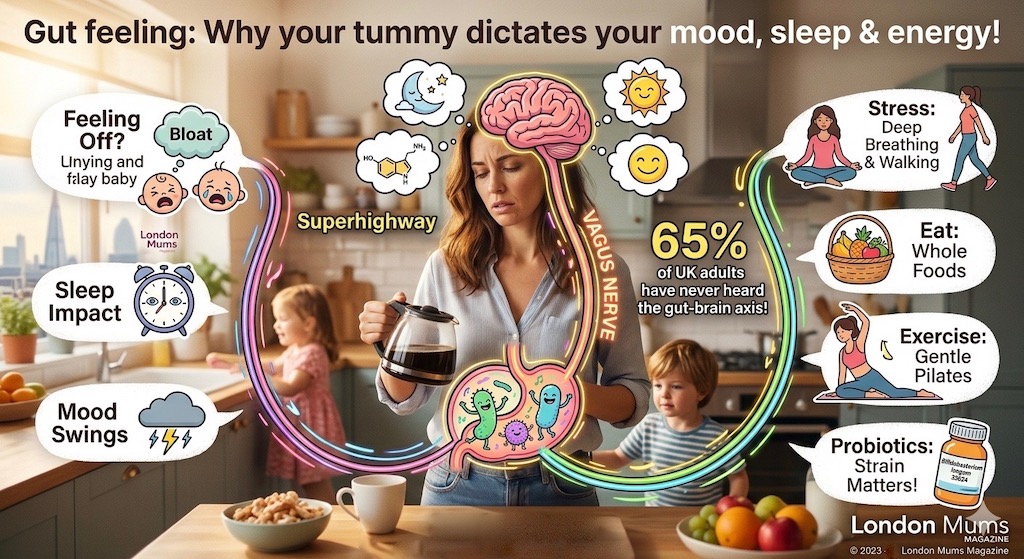
Scientists are increasingly focusing on something called the gut-brain axis – the constant, two-way conversation between your digestive system and your central nervous system. And it turns out, that chat has a huge influence on how you sleep, how much energy you have, and even how you feel emotionally.
Yet, a real-world survey of 1,000 UK adults commissioned by PrecisionBiotics (March 2026), a staggering 65% of people have never even heard of the gut?brain axis.
Let’s change that.
The numbers don’t lie: Brits are struggling
The survey paints a clear picture of widespread digestive discomfort:
- 43% have experienced bloating
- 42% have had diarrhoea
- 42% have suffered stomach pains
- 37% have dealt with excess wind
- 35% have had stomach cramping
And this isn’t just a minor annoyance. Digestive issues are affecting daily life in measurable ways:
- 34% say digestive discomfort impacts their sleep quality
- 27% say it affects their mood or emotional wellbeing
- 22% say it affects physical activity
- 16% have actually taken time off work
- 13% avoid exercise because of gut issues
Dr Nisa Aslam, a GP with a special interest in nutrition and adviser to PrecisionBiotics, explains: “When the gut microbiome is disrupted – a state called dysbiosis – it can lead to various problems, particularly with sleep, immune health and energy.”
How your gut talks to your brain (and why you should listen)
The gut-brain axis operates through four main communication pathways: neural, endocrine, immune, and metabolic. In plain English? Your gut and brain are constantly texting each other.
1. The neural pathway: A long nerve called the vagus nerve runs directly from your brain all the way down to your gut. It’s the superhighway of the gut?brain connection.
2. The endocrine pathway: Your gut produces hormones that influence mood, appetite and sleep. Did you know that 95% of your body’s serotonin – the “happy hormone” – is made in your gut? Serotonin is also a precursor to melatonin, the sleep hormone. Less serotonin could mean less melatonin – and more nights staring at the ceiling.
3. The immune pathway: Around 70-80% of your immune system lives in your gut. When your gut is out of balance, it can trigger low-grade inflammation that affects your brain, your mood, and your energy levels.
4. The metabolic pathway: Gut bacteria break down food into short-chain fatty acids, which are thought to influence brain function and behaviour.
Dr Emma Derbyshire, a nutritionist and adviser to PrecisionBiotics, puts it simply: “Your gut contains your gut microbiome – trillions of different bacteria. This can have a big impact on your overall health.”

Sleep, energy and immunity: the gut’s hidden role
Sleep: The survey found that 35% of people struggle to sleep due to digestive issues. And it’s a two-way street – poor sleep also worsens gut health. A research review shows that gut dysbiosis worsens sleep, while poor sleep worsens gut health. So that broken night might be both a cause and a consequence.
Energy: Your daily energy is partly controlled by how efficiently your gut converts food into fuel. Add poor sleep to the mix, and it’s no wonder you’re dragging yourself through the afternoon.
Immunity: Always catching the cold that’s doing the rounds at school? An unbalanced gut can alter immune pathways, triggering inflammation that leaves you run?down and vulnerable.
Dr Nisa Aslam adds: “Stress actually increases gut permeability – allowing bacteria to seep into the bloodstream, where it triggers an inflammatory response. That’s bad news for your health and wellness.”
And the public seems to sense this. A high 69% of survey respondents agreed that “stress can affect digestion, and digestive issues can increase stress” – a classic vicious cycle. Meanwhile, 71% agreed that “when my digestion feels settled, I feel calmer and more balanced overall.”
Five practical ways to support your gut?brain axis
The good news? You don’t need a complete lifestyle overhaul. Small, consistent changes can make a real difference. Here’s what the experts recommend.
1. Tackle stress – even for ten minutes a day
Only 8% of people in the survey said they actively manage stress when they have digestive changes. But Dr Emma Derbyshire says even simple habits help: “A 10-minute walk, deep breathing, limiting screen time before bed, or taking regular breaks during the day can reduce stress. Over time, these habits support both mental wellbeing and gut health.”
2. Stick to a consistent sleep schedule
Aiming for seven to nine hours of quality sleep, and going to bed and waking at the same times each day, helps both your gut and your brain. Try to stop eating a couple of hours before bed so your digestion isn’t still working overtime.
3. Keep moving – gently
Exercise reduces stress and improves the gut microbiome. You don’t need to run a marathon. Jogging, walking, cycling, swimming, even Pilates all count. Schedule it in and make it a priority.
4. Focus on whole foods, not ultra-processed ones
Ultra-processed foods (the ones with long ingredient lists and too much sugar, salt and saturated fat) are linked to decreased microbial diversity and increased inflammation. Instead, aim for fruits, vegetables, meat, fish, eggs, dairy, grains and nuts. Your gut will thank you.
5. Know your probiotics – strain matters
Only 11% of people currently take a probiotic supplement. But certain bacterial strains have been specifically studied for the gut?brain axis. These include Bifidobacterium longum 35624 (which mothers naturally pass to their infants) and Bifidobacterium longum 1714, shown to help the body respond to stress.
Dr Emma Derbyshire notes: “Probiotics can play a big part here. The right strains can help deliver targeted benefits to support the gut?brain axis.”
I’ll be honest. Before reading this research, I’d never really thought about my gut as a chatty neighbour to my brain. But the more I learned, the more it made sense. Those days when I’m bloated and tired? I also snap more easily. The nights I sleep badly? My stomach feels off the next day.
It turns out my gut and brain have been gossiping about me behind my back.
The takeaway? Looking after your gut isn’t just about avoiding uncomfortable bloating. It’s about sleeping better, feeling more energetic, and maybe – just maybe – not wanting to hide from your children before lunchtime.
Start small. Swap one processed snack for an apple. Take five minutes to breathe. And if you’re curious about probiotics, look for strains backed by real science.
Your gut – and your brain – will thank you.

Monica Costa founded London Mums in September 2006 after her son Diego’s birth together with a group of mothers who felt the need of meeting up regularly to share the challenges and joys of motherhood in metropolitan and multicultural London. London Mums is the FREE and independent peer support group for mums and mumpreneurs based in London https://www.londonmumsmagazine.com and you can connect on Twitter @londonmums
