

There are moments in life when the universe seems to whisper directly to you. For me, that whisper came in the form of six ruby-red fruits hanging from a tree in my grandparents’ garden in northern Italy. I had returned to the house in Romagna where I spent so many childhood summers, a place now filled with the echoes of my grandparents. My granddad, Dante Marcucci, a well-known and much-loved surgeon, had devoted his life to healing others. His presence still feels woven into the very soil of that garden. So when my son Diego and I wandered to the back, past the rose garden and the old persimmon tree, we stopped in our tracks. There it was: a pomegranate tree, heavy with fruit. I remembered it when it was barely a sapling. My uncle had planted it years ago after he was diagnosed with high blood pressure. He’d heard that pomegranates could help. Back then, it was a hopeful little stick in the ground. Now, it was a sprawling, generous tree with deep roots and six magnificent fruits, each one a promise fulfilled.
Diego looked up at me, his eyes wide. “Mamma, it’s like a present from Nonno and uncle Dedo.”
He was right. It felt like a gift from the family we had lost, a quiet message from heaven saying: We’re still looking after you.
The timing was almost uncanny. Only a few years ago, I too had been diagnosed with high blood pressure. And here, in the garden of my ancestors, was a tree my uncle had planted for the very same reason. A tree that was now bearing fruit for me.
Diego and I picked the pomegranates carefully, as if handling treasure. They weren’t at their absolute peak of maturity, it was late September, and they needed a few more weeks of Italian sunshine, but when we cracked one open, the arils inside were still wonderfully sweet and natural. No chemicals, no plastic packaging, no air miles. From the producer (us) to the consumer (still us). Zero kilometres.
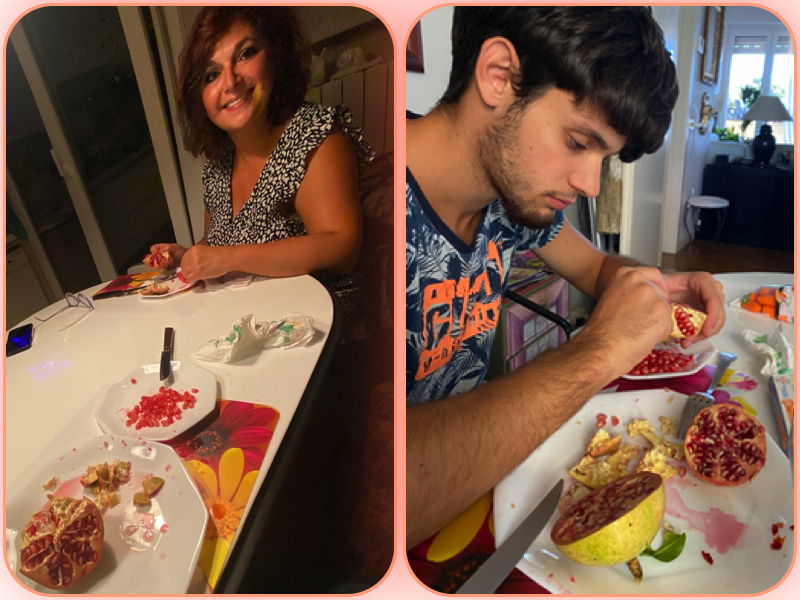
We ate them straight from the tree, the juice staining our fingers and our smiles. It was, without exaggeration, one of the most meaningful things I have ever tasted.
That moment sparked a journey. I wanted to know everything about this fruit that had appeared in my life like a blessing. And what I discovered has made Diego and me true pomegranate devotees. We now eat them every day during their season, whether we’re in Italy or back home in London.
What makes the pomegranate so special?
Pomegranates can be a little intimidating. Cutting one open requires some precision, and those little ruby-red arils seem to hide behind a fortress of white pith. But nutritionists agree: they are absolutely worth the effort.
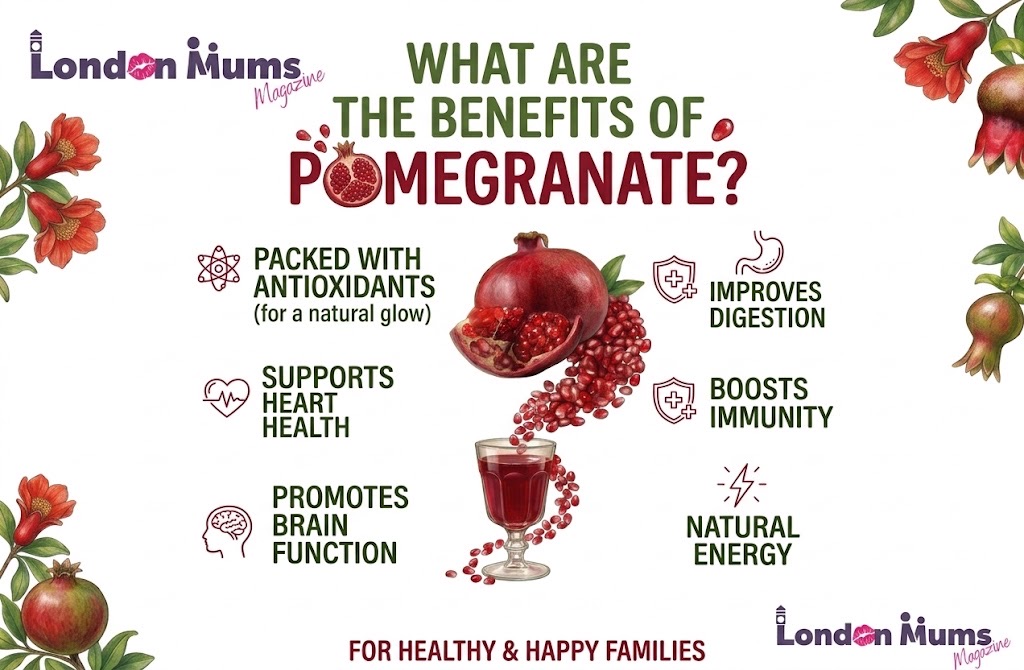
The pomegranate is one of the most antioxidant-rich fruits on the planet. Its polyphenols, including ellagitannins and punicalagins, are what give it that distinctive tart flavour and its powerful protective effects. These compounds help reduce inflammation and oxidative stress in the body, which in turn supports healthy arteries.
And for someone like me, with a diagnosis of high blood pressure, the research is genuinely encouraging.
A landmark 2017 review published in Pharmacological Research analysed eight randomised controlled trials and found that pomegranate juice significantly reduced both systolic and diastolic blood pressure. Systolic pressure (the top number) dropped by an average of nearly 5 mmHg, and diastolic pressure (the bottom number) by about 2 mmHg. Importantly, the effect held steady regardless of how much juice people drank or for how long.
The review concluded that “it may be prudent to include this fruit juice in a heart-healthy diet”. For those of us managing hypertension, that’s a powerful statement.
Beyond blood pressure, pomegranates also help protect LDL (“bad”) cholesterol from oxidative damage and support overall circulation. The antioxidants work to improve how blood vessels relax and widen, which is exactly what you want when your blood pressure is running a little too high.
A nutritional powerhouse for the whole family
When I started looking at the nutritional profile of pomegranates, I was even more impressed. A 100g serving of the edible arils: those juicy little seeds provide around 4 grams of dietary fibre (about 20% of your daily value), 10.2mg of vitamin C, 16.4mcg of vitamin K, and 38mcg of folate. That’s a lot of goodness packed into a fruit that children genuinely enjoy eating.
The fibre is particularly important. Most of us and most of our children don’t get enough. Pomegranate arils are a delicious way to close that gap. And because you eat the whole aril, including the crunchy seed inside, you get the full fibre benefit. It’s nature’s original finger food.
Diego loves them just like that eaten from the place with the spoon after carefully removing them from the shell. I’ve started adding them to our evening meals too, and I’ve found that their sweet-tart flavour brightens up everything from roast vegetables to grain bowls.
A fruit steeped in history
What I love most about the pomegranate is that it isn’t just a modern wellness trend. It has been revered for thousands of years.
The ancient Egyptians regarded it as a symbol of prosperity and ambition. A Roman statue of Aegyptus, the personification of Egypt, depicts him holding a pomegranate, a sign of the fruit’s enduring cultural significance across civilisations.
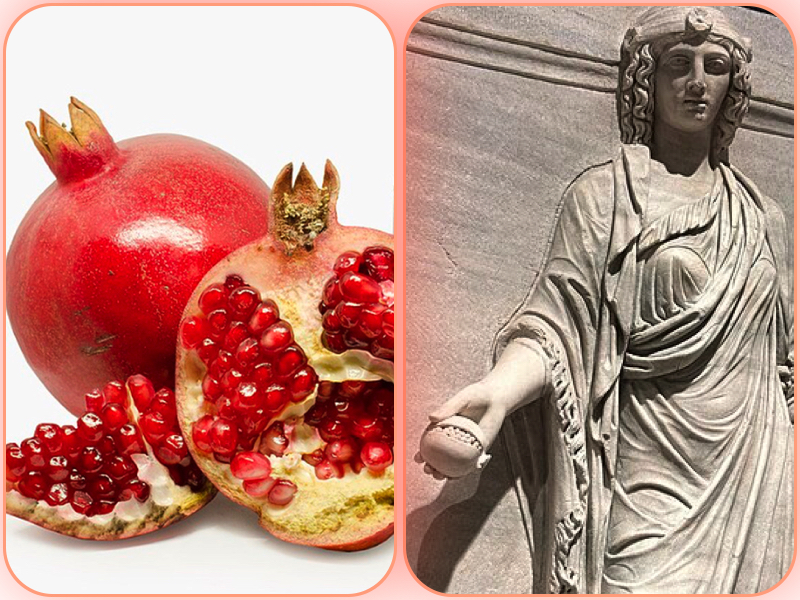
Even the name carries history. “Pomegranate” comes from the medieval Latin p?mum (apple) and gr?n?tum (seeded), literally, a seeded apple. The old French pomme-grenade gave us the word for the military grenade, and the gemstone garnet takes its name from the same root, a nod to the fruit’s deep red colour.
In Persian cuisine, pomegranate molasses is a key ingredient in dishes like fesenj?n, a rich, sweet-sour walnut stew that is traditionally served at celebrations. I’ve started experimenting with it at home, and the depth of flavour it adds to a simple chicken dish is extraordinary.
Bringing pomegranates into our London kitchen
Here in London, we can’t grow pomegranates in our gardens: our climate is just not warm enough. But that doesn’t mean we have to miss out. Pomegranates are readily available in UK shops from September through to February, imported from Spain, Turkey, Egypt, and beyond.
The key is to buy them when they’re in season. A ripe pomegranate should feel heavy for its size, as if it’s full of juice. The skin should be firm and taut, with a fresh leathery appearance. Don’t worry about minor surface marks, they don’t affect the quality inside.
If you’re short on time, you can cut the pomegranate in half vertically, hold it cut-side down over a bowl, and whack the top with the back of a large spoon. The arils will tumble out like little jewels.
For London mums looking for easy ways to incorporate pomegranate into family meals, here are a few ideas:
- Breakfast: Sprinkle arils over porridge, yoghurt, or pancakes.
- Lunch: Add them to a salad with spinach, avocado, and toasted walnuts.
- Dinner: Scatter them over roast cauliflower with tahini, or use pomegranate molasses as a marinade for chicken or lamb.
- Snacks: A small bowl of arils is a perfect after-school treat, sweet, juicy, and packed with fibre.
You can find pomegranate molasses at many London shops, from Partridges in Kensington to Turkish and Middle Eastern grocers across the city.
A gift that keeps giving
Every time I cut open a pomegranate, I think of that tree in my grandparents’ garden. I think of my uncle, who planted it with hope. I think of my granddad, the surgeon who spent his life caring for others, and my grandmother, whose kitchen always smelled of something wonderful.
And I think of Diego, who saw a tree full of fruit and recognised it for what it was: a present from the family who watches over us.
I don’t know if pomegranates will lower my blood pressure as much as the medication I take. I’m not a doctor, and I’m certainly not suggesting anyone replaces medical treatment with fruit. But I do believe in the power of small, daily choices. I believe in the wisdom of our ancestors, who revered this fruit for its beauty and its benefits long before we had clinical trials to prove them.
And I believe in the comfort of a bowl of ruby-red arils on a grey London morning, a taste of Italian sunshine, a memory of my grandparents, and a little act of love for my own heart.
So here’s to the pomegranate. May it continue to bless our tables, our health, and our memories for generations to come.

Monica Costa founded London Mums in September 2006 after her son Diego’s birth together with a group of mothers who felt the need of meeting up regularly to share the challenges and joys of motherhood in metropolitan and multicultural London. London Mums is the FREE and independent peer support group for mums and mumpreneurs based in London https://www.londonmumsmagazine.com and you can connect on Twitter @londonmums
