
There are theatre evenings when you leave humming a tune, and others when you leave with something rather deeper on your mind. Holy Fool at Park Theatre in Finsbury Park belongs firmly in the second category, but thankfully, it also gives you plenty to smile along the way.
I went to see Holy Fool with a friend yesterday, and we both came out pleasantly impressed and, more importantly, deeply touched by this fascinating story of art, censorship, courage and survival.
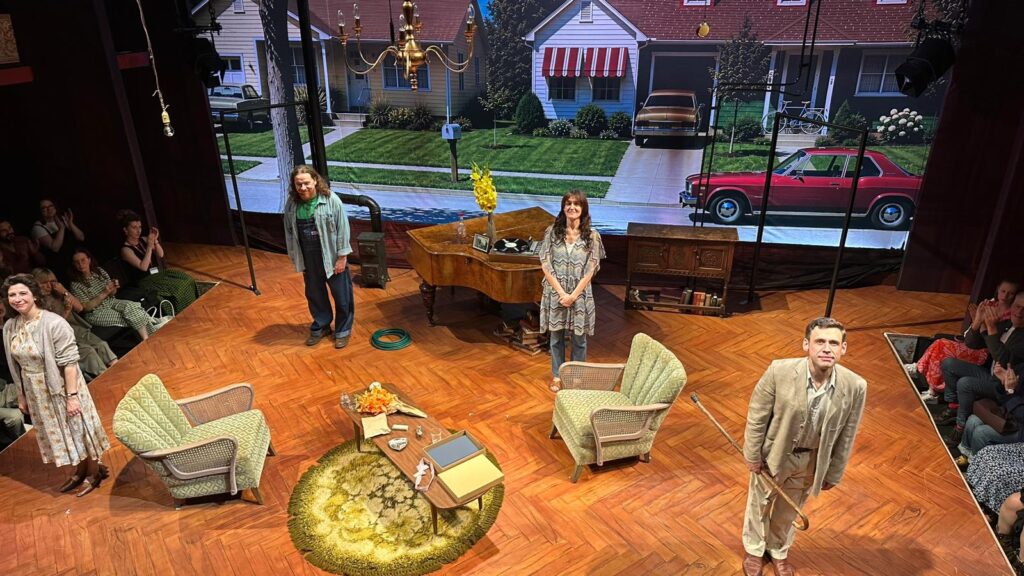
Written by Rosalind Adler and Lea Sellers and directed by Kate Fahy, it tells the story of Dmitri Shostakovich, one of the great composers of the 20th century. The production is currently running at Park Theatre from 4 September to 10 October 2026.
A composer caught between art and tyranny
Shostakovich became one of the Soviet Union’s most celebrated composers. His First Symphony, written when he was still very young, brought him international recognition, but his relationship with the Soviet authorities was anything but straightforward.
He lived through the Russian Revolution, Stalin’s dictatorship and the Second World War, composing music under a regime where artistic freedom could quite literally become a matter of life and death.
Shostakovich was heavily criticised by the Communist Party newspaper and lived for years with the knowledge that a wrong artistic decision could have devastating consequences. He was repeatedly praised and condemned by the authorities – sometimes seemingly within the same breath.
This is the fascinating paradox at the heart of Holy Fool: how do you remain an artist when the people in power are effectively telling you what you are allowed to create?
The answer, at least in Shostakovich’s case, was sometimes to say one thing publicly and another through the music itself. Park Theatre describes the play as a story of a composer who has to appease a brutal despot while quietly resisting him, composing in code and hiding meaning beneath the surface.
And that makes the story feel surprisingly contemporary.
When politics starts dictating art
What struck me most was how easily the story travels from Stalin’s Soviet Union into our own times.
Censorship is not simply something that belongs in history books. Whenever governments, institutions, political movements or powerful groups try to control what artists can create, what journalists can report or what ordinary people are allowed to say, freedom of expression starts to become conditional.
Art needs freedom to question, challenge and sometimes make us uncomfortable. Journalism needs the freedom to investigate. Society needs people who can disagree with those in power without fearing that their careers, livelihoods or personal safety will be destroyed.
The Soviet system took this to an extreme, with artists and intellectuals subjected to campaigns of denunciation and ideological control. But the broader question raised by Holy Fool is much more universal: what happens to a society when people become afraid to speak?
That is what makes this production more than simply a historical drama about a famous composer.
Serious, but with plenty of humour
Now, before I make this sound like two hours and twenty minutes of unrelenting misery, let me reassure you: Holy Fool is also funny.
There are some genuine comedy-gold moments scattered throughout the story. The humour works particularly well because it doesn’t undermine the seriousness of what is happening. Instead, it gives the audience some breathing space.
And that is important. When the subject matter involves Stalin, censorship, torture, fear and death, a little humour can be a very welcome release.
The production gradually moves towards a lighter atmosphere too, giving us a sense that there may be a future beyond the darkness. Without giving too much away, history does provide the ultimate plot twist: dictators don’t live forever.
Stalin died in 1953, and Shostakovich went on to enjoy some of his greatest professional successes in the years that followed. His legacy eventually became firmly established as one of the most important musical voices of the 20th century.
Some seriously impressive acting
For my friend and me, the absolute highlight of Holy Fool was the acting.
There are only four actors throughout the production – Jenna Augen, Fergus O’Donnell, Benjamin O’Mahony and Phoebe Pryce – and they are all excellent.
They manage to move convincingly between tragedy, tension and comedy, often within the same stretch of the story.
My personal favourite was Benjamin O’Mahony in the main role. He was absolutely brilliant. His performance communicates fear, exhaustion, cold and illness in a way that feels almost physical. There were moments when you could genuinely feel his character’s vulnerability, and he managed to make us shiver simply by watching him.
It is the sort of performance that reminds you why live theatre can be so powerful. You aren’t watching somebody on a screen who was filmed weeks or months ago. You are sitting metres away from an actor who is creating those emotions right in front of you.
And then there is Park Theatre…
I have always loved going to Park Theatre. It is nothing like the huge, glittering West End theatres – and that is precisely why I like it.
There is something edgy, intimate and wonderfully relaxed about the place. The theatre’s layout creates a particularly close relationship between actors and audience, making you feel almost as if you have been dropped inside the story rather than simply sitting outside it.
You also get a great view from practically everywhere, which is a big advantage when you are watching a play where the acting is doing so much of the heavy lifting.
And, of course, there is the other big attraction: you can experience excellent theatre without necessarily paying West End prices. Holy Fool currently has tickets ranging from £22.50 to £55, with various concessions and discounts also available.
After all the West End glitter, I have to admit I was missing something a little deeper. Holy Fool was exactly what I needed.
The verdict
Holy Fool is poignant, intelligent and unexpectedly funny. It tells a very specific story about one extraordinary composer, but the questions it asks are much bigger: How much freedom are we prepared to surrender? What does an artist do when creativity becomes dangerous? And can art survive censorship?
For me, the answer offered by this production is an encouraging one. Art may be silenced temporarily, manipulated or censored, but it has a remarkable habit of surviving.
If you enjoy serious drama, outstanding acting and theatre that gives you something to think about on the way home, I would definitely recommend Holy Fool.

Hi, I’m Francesca! I live in central London and I’m rarely home — there’s always a gallery, gig, or show pulling me out the door. My real loves are music, art and theatre, but I’m just as happy exploring history, sport, or whatever’s newly opened and worth talking about. I’m on a constant search for London’s most enriching experiences, big and small, and I’m here to help you find them too.
