

As a film enthusiast and an Italian mother raising a family in London, I am constantly searching for stories that resonate with the complex tapestry of modern womanhood. Between the school run, the pasta boil, and the bedtime stories, there is little time for the cinema. But every so often, a film comes along that doesn’t just deserve a babysitter and a night off – it demands one.
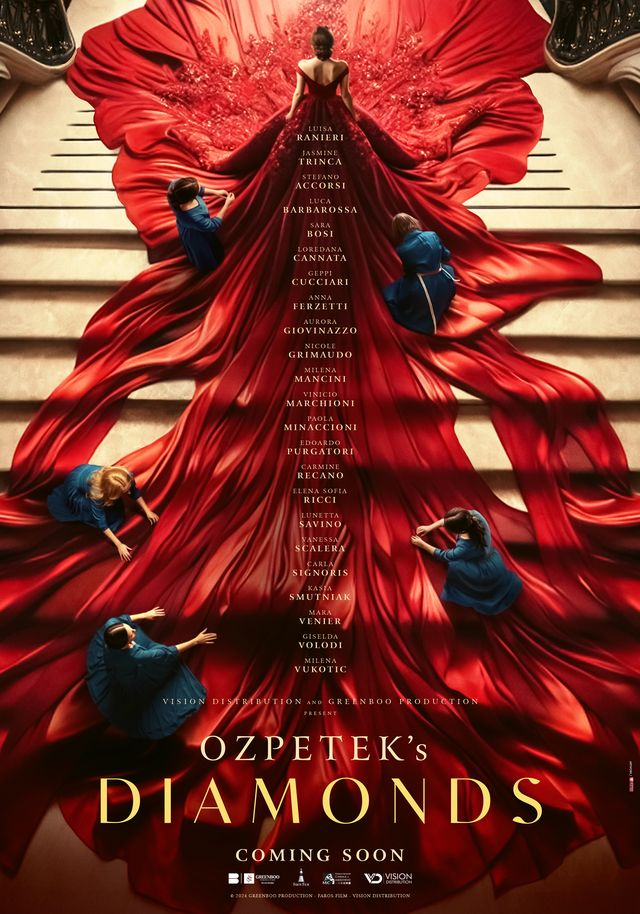
Few films have moved me as profoundly as Ferzan Özpetek’s latest masterpiece, Diamanti (Diamonds). Ahead of my face-to-face interview with the visionary Turkish-Italian director for London Mums, I managed to secure an early viewing. I walked in hoping for a nostalgic trip to Rome. I walked out utterly captivated, my soul filled with tears of joy. This is more than a movie; it is a dazzling, heartfelt celebration of female strength, solidarity, and the unbreakable bonds forged in the most unexpected of places: a 1970s costume atelier.
A ‘Vaginadrome’ of positivity
Let me set the scene. The film opens with a wonderfully meta twist. We are in the present day, and Özpetek himself (making a rare on-screen appearance) gathers eighteen of Italy’s most beloved actresses around a long, sumptuously decked table. They are there to read the script for the very film we are about to watch. As the sharp-witted Sardinian actress Geppi Cucciari wryly says it, this is a “vaginadrome” – a term that perfectly sets the tone for a story unapologetically centred on women. It is hilarious, self-aware, and instantly endearing.
We are then swept back in time to Rome, 1974. The glittering chaos of the city is happening outside, but inside the prestigious Canova sisters’ atelier, life hums to a different rhythm: the whir of sewing machines, the rustle of silk, and the clink of scissors.
The Canova Sisters: Heart and hustle
At the helm are two formidable siblings. Alberta (Luisa Ranieri) is the driven business mind – steely, graceful, and hiding a secret wound of a love who abandoned her in Paris eighteen years prior. Her sister, Gabriella (a magnetically gentle Jasmine Trinca), is the emotional core, still quietly grieving the loss of her young daughter. Their dynamic – a blend of love, friction, and mutual dependence – anchors the entire narrative. As Gabriella chides Alberta: “You have become cold, icy, merciless. You trample on people.” But we soon learn that behind Alberta’s iron facade lies a woman who knows exactly where she wants to be: right here, building this sanctuary.
A tapestry of women, not just seamstresses
This is no ordinary dressmaker’s shop. It is a sanctuary, a battleground, and a stage. Özpetek doesn’t just tell one woman’s story; he weaves a tapestry of them. And what a tapestry it is.
- Nina (Paola Minaccioni) is the head seamstress, navigating her teenage son’s existential crisis at home.
- Nicoletta (Milena Mancini) has nimble fingers but a spirit being broken by a violent husband, Bruno.
- Carlotta (Nicole Grimaudo) is the dyer, bringing vibrancy to both fabrics and lives.
- Silvana (the national treasure, Mara Venier, aka zia Mara) is the cook – the warm-hearted ‘mamma’ or ‘auntie’ of the shop who serves up advice and lasagne with equal grace.
Then there is the rebellious niece, Beatrice (Aurora Giovinazzo), who hides from the police after a protest and, by night, secretly adds her own radical flair to 18th-century historical costumes. As one character perfectly puts it: “Art is all a betrayal.” These small acts of creative rebellion are where true beauty is born. Personally, Beatrice’s character brought me to tears every time I saw her on screen as I recognised myself in her.
My personal goosebumps moment
As an Italian mother watching this in London, I felt my heart swell with recognition. There is a particular scene where the young labourer is coaxed into singing. The atelier transforms into an impromptu dance hall, bodies moving between mannequins and bolts of fabric. I had goosebumps. It was unadulterated joy – the kind that only happens when women decide to lift each other up.
And then there is the brilliance of the Rossana. One of the sisters recalls the childhood favourite of a lost little girl, Amelia – the Rossana caramel. The red, glittering wrappers of these century-old sweets (caramelle dell’amore) are then used by the costume designer to give light to a crimson gown for a film. It is a stunning visual metaphor: hard on the outside, soft and creamy within, wrapped in red and gold. Like the women themselves. Like us.
The ‘Blue Buttons’ code: Saving lives
But Diamanti is not just beautiful; it is vital. The atelier becomes a metaphor for life itself, and the women develop a coded language that brought tears to my eyes. “Pink buttons” means all is well. “Blue buttons” is a distress call – a signal that brings every single woman in the shop running to protect one another.
We see it when Nicoletta’s violent husband looms. The women don’t hesitate. They form a wall. The film argues, powerfully, that femicide is prevented when women help each other. As a mother raising a son in a big city, that message hit me like a thunderbolt. Sorellanza (sisterhood) is not just a nice idea; it is a shield, a survival tactic, a revolution stitched in silk.
A few flaws (because nothing is perfect)
If I am being entirely honest as a critic, we don’t see much of the male characters. The men, while beautiful (“stupendi mezzi nudi” as the seamstresses cheekily note when measuring them), serve mostly as elegant plot devices. Stefano Accorsi is brilliant as the exasperated director, and Luca Barbarossa makes a charming cameo, but this is undeniably a world stitched by women, for women. And frankly, that is its greatest strength.
The verdict: A Diamond for every mother
Özpetek dedicates Diamanti to three diamonds of Italian cinema – Mariangela Melato, Virna Lisi, and Monica Vitti – but it feels like a dedication to every woman who has ever found refuge in work, in friendship, or in a shared plate of pasta.
For us London mums, who often juggle dual identities (British and Italian, mother and professional, exhausted and resilient), this film is a stunning reminder that like diamonds, women shine brighter when we stand together.
Whether you need a cry, a laugh, or simply two hours of transportive beauty that makes you proud to be a woman – and an Italian woman – go see Diamanti. It is elegant, powerful, and utterly unforgettable.
Stay tuned for my full interview with Ferzan Özpetek this week, where we discuss the ‘blue buttons’ code, the magic of Rome, and why he believes cinema is the ultimate act of betrayal.
Diamanti is in select UK cinemas now.
London Mums’ rating: 10/10
Best enjoyed with: A box of Rossana caramelles and a glass of Prosecco.
The trailer
More articles you might enjoy
www.londonmumsmagazine.com/category/entertainment/italian-culture-ezine
Monica Costa founded London Mums in September 2006 after her son Diego’s birth together with a group of mothers who felt the need of meeting up regularly to share the challenges and joys of motherhood in metropolitan and multicultural London. London Mums is the FREE and independent peer support group for mums and mumpreneurs based in London https://www.londonmumsmagazine.com and you can connect on Twitter @londonmums
