

There are books you admire, and then there are books that quietly shape the way you see the world. For me, The Odyssey belongs firmly in the second category. I first met Odysseus, or Ulisse, as we called him in my Italian classroom, as a teenager, and I’ve been slightly in love with the crafty old wanderer ever since. So when I heard Christopher Nolan was taking a crack at it, I felt the same flutter of excitement I get when someone promises me a quiet cup of tea and actually delivers.
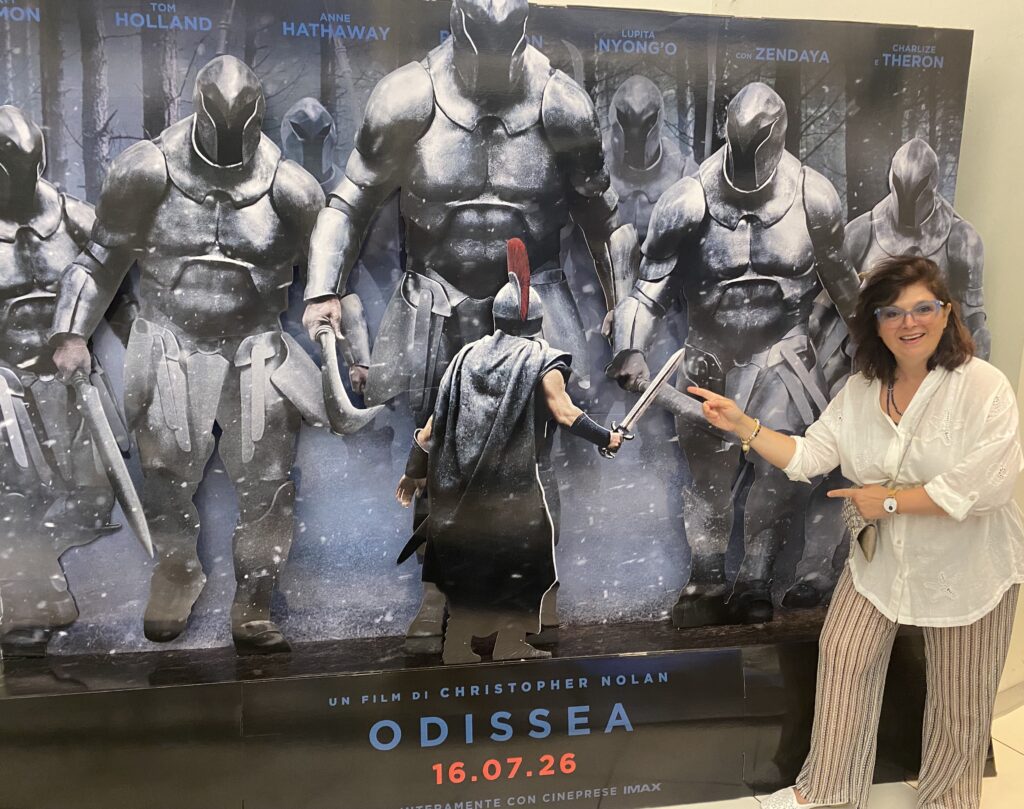
But I am a mum now, and the last time I tried to explain the story of the Trojan War to my son, he asked if the Trojan Horse was a computer virus. So I went into Nolan’s 172-minute IMAX epic with two questions: will it make me fall in love with the story all over again, and will my (now 19 year old) son have a clue what’s going on? The answer to both, somehow, is yes.
A quick catch-up for anyone who didn’t study Classics (or has forgotten everything)
Odysseus, King of Ithaca, husband to the very patient Penelope, dad to Telemachus, pops off to fight the Trojan War, a decade-long siege that ends with his greatest hit, the wooden-horse trick. So far, so clever. Then he sets sail for home, and that’s where it all goes magnificently wrong. Another ten years of wandering, because apparently the Mediterranean is a very tricky place to navigate when you’ve annoyed the god of the sea.
What follows is a sort of ancient gap year from hell. He and his crew wash up on the island of the Cyclops, where they meet Polyphemus, a one-eyed giant with a taste for human flesh, and escape only after Odysseus gets him drunk, tells him his name is “Nobody,” and then drives a burning stake into his eye. (Parenting tip: this is not a recommended strategy for getting out of a playdate.) Next comes Circe, a sorceress who turns half his men into pigs, literally, and keeps Odysseus as her guest-slash-lover for a full year. The Sirens, whose singing is so beautiful it lures sailors to shipwreck, require Odysseus to plug his crew’s ears with wax and have himself lashed to the mast, just so he can hear the music without jumping overboard. There’s Scylla, a six-headed monster who snatches men from the deck like popcorn, and Charybdis, a whirlpool that swallows the sea itself three times a day. He sails between them and loses more men. At one point, desperate for directions, Odysseus actually descends into the Underworld to consult a dead prophet. He meets his own mother down there, didn’t even know she’d died, and it’s quietly devastating. And let’s not forget the lotus-eaters, whose flowers make his crew so blissfully forgetful they don’t want to leave the island ever again. The whole thing is an epic mash-up of adventure, horror, temptation, grief, marital guilt, and an awful lot of poor decision-making. Meanwhile, back in Ithaca, a house full of suitors are eating his food, drinking his wine, and trying to marry his wife. It is, in short, the original blockbuster, and the longest midlife crisis in literary history.
Nolan does what Nolan does
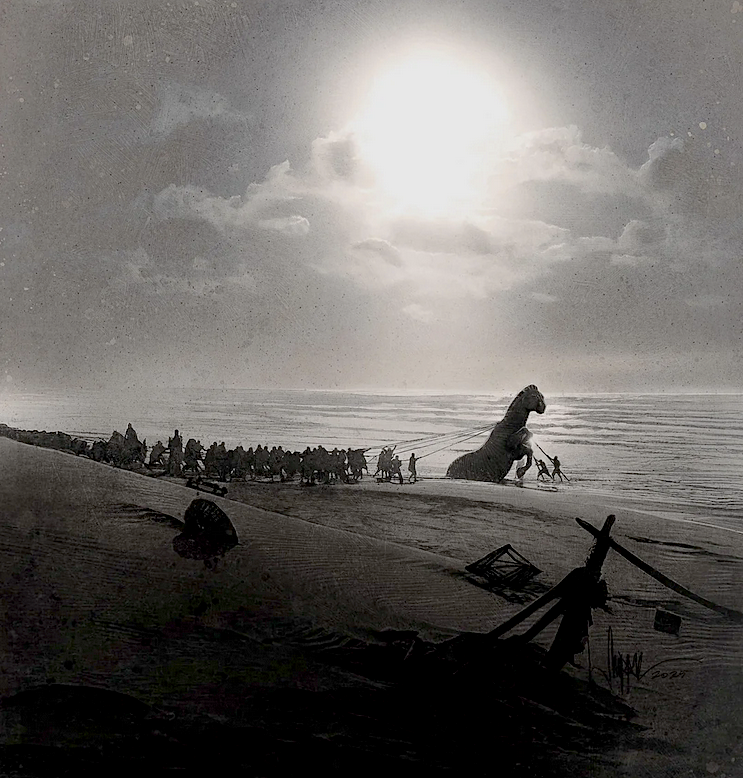
Nolan being Nolan, he doesn’t tell the story in a straight line. The film opens not with Odysseus leaving Troy, but with a man standing on a banquet table telling a story, which is itself a story within a story. If that sounds confusing, it is. Time skips about like a toddler on a sugar high. One minute we’re inside the Trojan Horse (which, by the way, looks less like a wooden pony and more like a half-buried art installation dragged through the shallows), the next we’re watching a grown-up Telemachus (Tom Holland, very earnest) searching for a father he barely remembers. There were moments I wanted to hand out a timeline and a family tree to everyone in the row.
But for those who can relax into it, the time-hopping is beautiful. Nolan treats memory the way we actually experience it, not as a neat timeline, but as a jumble of moments that change meaning the older we get. When a middle-aged Penelope (Anne Hathaway, radiating regal exhaustion) remembers her young husband leaving for war, you feel the ache of every military spouse in history.
Will the kids get it?
If your teenagers think The Odyssey is just a name on a dusty GCSE syllabus, they might find the first 30 minutes utterly baffling. I’d suggest a tiny bit of homework, not the whole epic poem, just a five-minute family briefing over dinner. Who’s who, what’s the Trojan Horse, why the one-eyed giant is so grumpy. The film rewards those who do their prep, but it doesn’t spoon-feed. There are no ChatGPT-style explainers, thank goodness, but there’s also very little hand-holding.
My friend’s 15-year-old daughter would probably adore it for the spectacle and the constant near-death experiences. She would ask, “Is he dead? What about now?” So: older teens and curious adults, yes. Little ones, leave them with a babysitter and a copy of the Percy Jackson books to plant the seed.
The cast is a glorious jumble sale of talent
Matt Damon’s Odysseus is a gruff, flawed, occasionally infuriating hero, less Greek god, more exhausted dad who’s made some spectacularly bad life choices. Tom Holland plays Telemachus with wide-eyed vulnerability, and yes, he calls Odysseus “my dad” in modern vernacular, which is either charmingly relatable or jarring, depending on your tolerance for anachronism. Robert Pattinson, as the lead suitor Antinous, is so vile you’ll want to throw popcorn at the screen. Zendaya floats in and out as Athena, visible only to Odysseus, like a very glamorous imaginary friend. And Lupita Nyong’o pulls double duty as Helen and her twin sister Clytemnestra. Homer belongs to everyone, and Lupita is magnificent.
Is it family-friendly?
There’s a lot of violence, too much for my liking. Repetitive battle scenes (even a recap at the end which could easily be removed without changing the narrative). I have the impression that the bloody scenes are added to satisfy the youngsters taste. The sack of Troy is genuinely horrifying, burning buildings, bodies in the street, the implication of terrible things done to women and children. We don’t see the worst of it, but we feel it. This isn’t a swords-and-sandals romp with cartoonish deaths; it’s a film about the moral cost of war, and it sits heavy. There’s also Odysseus getting addicted to lotus flowers on Calypso’s island, which plays like a very chic, terrifying depiction of dissociative drug use. Charlize Theron as Calypso is charming, but the whole sequence might prompt some interesting conversations you weren’t planning to have over a post-cinema pizza.
So, certificate-dependent, I’d say 14+ for mature teens, and even then, be ready to talk about what you’ve just seen. Which, honestly, is one of the best reasons to watch it as a family.
The verdict: go, but pack your brain
Nolan’s Odyssey is massive, tactile, thought-provoking, and occasionally maddening. It looks and smells real, you can practically taste the sea salt and the blood. It takes wild liberties with the source material and yet somehow captures its spirit more faithfully than a dozen more “accurate” adaptations. It’s a film about the stories we tell ourselves to survive, and the ways we keep getting lost and found and lost again. Which is, when you think about it, pretty much the story of parenting too.
Take your older teens. Have a pre-film strategy session. Let the images wash over you. And if you come out a bit bewildered, remember: even Odysseus took ten years to get home. A couple of hours of confusion is nothing.
London Mums’ rating: 7/10
The Odyssey is in UK cinemas now. Run time 172 minutes. Not for the faint-hearted, the very young, or anyone who skipped the Wikipedia plot summary.
The trailer

Monica Costa founded London Mums in September 2006 after her son Diego’s birth together with a group of mothers who felt the need of meeting up regularly to share the challenges and joys of motherhood in metropolitan and multicultural London. London Mums is the FREE and independent peer support group for mums and mumpreneurs based in London https://www.londonmumsmagazine.com and you can connect on Twitter @londonmums
