

Most of what makes an older London flat lovely is the same thing that makes it awkward to childproof. Sash windows that actually open. Chimney breasts in the middle of rooms. Ceilings you need a ladder to reach. Walls that are plaster on brick rather than plasterboard on studs.
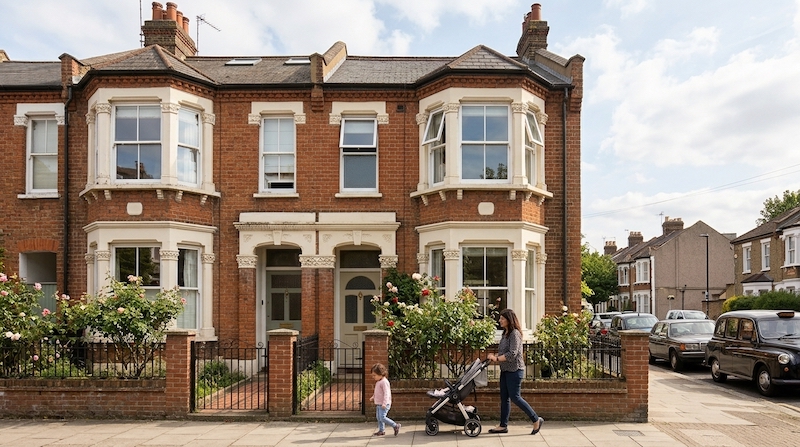
London has the oldest housing stock in England. An analysis of EPC records puts 55% of the capital’s homes at pre-1950, against 39% across England and Wales, and more than a third of them predate 1930.
More than 40 children under ten are admitted to hospital every day after a fall, according to the Child Accident Prevention Trust, and a small child’s head is proportionally heavier than an adult’s, so they tip forward easily and land on it.
The walls are the first job
Nearly every childproofing job that fails, fails at the fixing rather than the furniture. Victorian walls are usually brick or block behind lath and plaster. Solid enough to take a proper anchor, but a screw will bite into the plaster, feel tight, and hold nothing. Newer partition walls are the opposite problem: hollow behind a thin skin, with timber studs at intervals you cannot see.
Pick the fixing before you pick the shelf. Into masonry, use a plug rated for the load and a screw long enough to reach the brick. Into a stud wall, find the timber with a detector and fix there. On lath and plaster, test by pulling rather than by feel. Anything a child can climb needs a strap into something structural.
What actually goes over
Tall chests of drawers cause most of the damage, and it is the bottom drawer that does it. Open it and the weight shifts forward far enough that a five-year-old’s tug finishes the job. Bookcases, freestanding shelving, a television on a stand, a mirror propped in an alcove: all fine until someone leans on them.
Two habits cover most of it. Anchor anything whose top edge sits above your knee, and keep heavy things in the bottom of it. If the wall will not take a strap, empty the top two shelves and stop using the top drawer for anything a child wants.
Sash windows and stairs
Period windows open wide, and low furniture underneath them is a ladder. The trust’s guidance on falls from open windows is blunt about the numbers: one child under ten is admitted to hospital every day after falling from a building, and 16 children under eleven died from window and balcony falls across six years. Fit restrictors or locks, keep the key where a fire would not stop you finding it, and move the bed away from the sill.
Banisters are the other gap. Old spindles were spaced when nobody measured for children, and any gap a fist passes through will take a shoulder. Stair gates need a solid post to clamp to, so in a narrow hall a wall-mounted gate usually beats a pressure fit.
Write to the landlord before you drill
This is the part that catches renters. The Renters’ Rights Act has been arriving in stages, with the first reforms live from 1 May 2026, and it changed security of tenure, rent increases and pets. It changed nothing about the walls: decoration and alterations are still a matter for the tenancy agreement, and drilling without written consent is still a breach that can come out of a deposit.
So ask in writing, name the exact fixing, and offer to make good when you leave. A strap and a rawl plug are a small ask and most landlords say yes. If you would rather not touch the wall, or the wall is old enough that the fixing is a two-person job, a handyman near London who has drilled a hundred of these walls knows what is behind them.
The nursery in a room that was never one
Keep the cot out of the chimney alcove, away from the radiator, and clear of the window and its blind cord. Check the standard on any second-hand cot rather than trusting the person selling it: cots, highchairs, prams and car seats were removed from the scope of the UK flammability rules on 30 October 2025, and FIRA’s guide to children’s furniture standards sets out what still applies to each product type.
None of this needs a weekend or a drill of your own. It needs an hour, a detector and the right fixings for a wall built when Victoria was on the throne.

Monica Costa founded London Mums in September 2006 after her son Diego’s birth together with a group of mothers who felt the need of meeting up regularly to share the challenges and joys of motherhood in metropolitan and multicultural London. London Mums is the FREE and independent peer support group for mums and mumpreneurs based in London https://www.londonmumsmagazine.com and you can connect on Twitter @londonmums
