

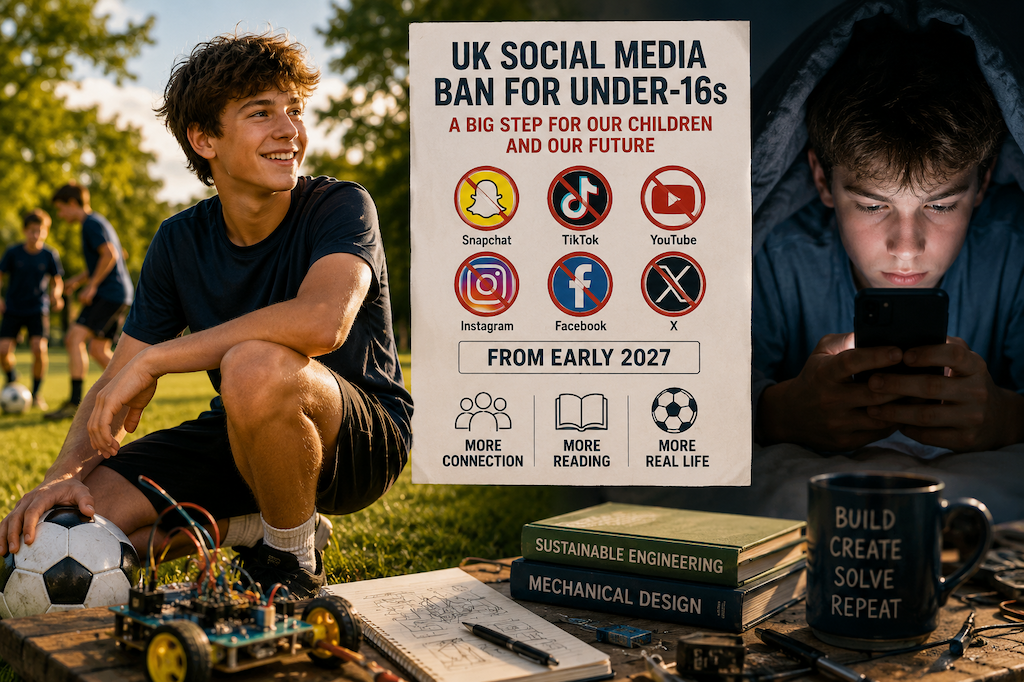
The news landed like a thunderclap in living rooms across the country. Under-16s will be banned from using Snapchat, TikTok, YouTube, Instagram, Facebook and X from early 2027. The government is also considering an overnight curfew and measures to stop infinite scrolling for under-18s. Prime Minister Sir Keir Starmer called it “a big moment for our country” and “a big step, a real change for our children and our future”.
As a mum, I felt a strange mix of relief and sadness. Relief that future generations might be spared the relentless grip of algorithmic feeds. Sadness that it took this long.
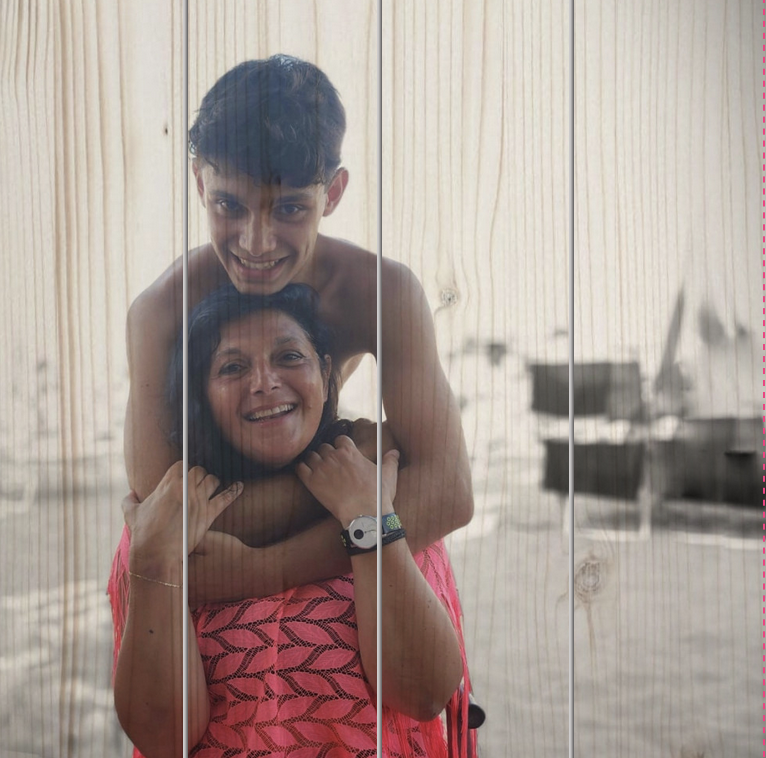
But here is the thing. My son Diego is almost 20 now. He did not get a mobile phone until he was 16, nearly 17. And I am convinced that decision shaped the young man he has become.
A different kind of childhood
While his friends were glued to screens, Diego was outside. He played sport. He cultivated hobbies. He built computers from scratch using scrap pieces, not because he had to, but because he wanted to. That curiosity and resourcefulness has now turned into something remarkable. He has started his own sustainable business with a friend, alongside his mechanical engineering studies at UCL.

I am not sure he would have done that if he had been hooked on social media nonsense from the age of 11.
Watching him grow up without a phone in his hand was not always easy. There were moments he felt left out. Times he asked why everyone else had one and he did not. But I held firm. And now I see the results: a young man who can hold a conversation, who reads, who builds, who creates. Not just scrolls.
What the ban actually means
The ban will cover platforms “whose purpose is to enable social interaction and which allow users to post material”. Messaging services like WhatsApp and Signal will not be included, nor will YouTube Kids. Features like livestreaming and strangers being able to contact children will also be restricted.
For under-18s, the government is looking at overnight curfews and breaks in infinite scrolling. AI “romantic companion” chatbots will have to enforce a minimum age of 18.
The regulations are expected to be passed before Christmas, with the ban coming into force by spring 2027.
How will it be enforced?
This is the million-pound question. The government says “highly effective age assurance” measures will be used, face scans or asking for ID. Ofcom has been asked to identify the best methods. Without accurate, continuous identity verification in place such a ban will only be superficial with tech-savvy children being able to work around the restrictions.
What the experts say
Child psychologist Dr Emily Crosby highlights that adolescence is a critical period for building identity and self-esteem. “Social media sites can provide distorted views of reality which can negatively influence a child and adolescent’s view of themselves and their lives,” she warns.
Dr Tom Maggs, a paediatrician, warns parents to expect a “social media withdrawal” period if restrictions are introduced. “When that habit is disrupted, it’s common to see irritability, boredom, restlessness and a strong urge to reach for a phone”.
Nevertheless, the ban is a much-needed intervention. For too long, we parents have been left to fight an uphill battle against platforms intentionally designed to be addictive.
However, a ban alone is not enough. If a child still has a smartphone with unhindered access to the internet, the core issues of digital distraction and vulnerability remain.
What parents can do now
School leaders from the Girls’ Day School Trust have shared eight practical steps parents can take before the ban comes into force:
- Ban phones from bedrooms – improve sleep and reduce late-night scrolling.
- Bring back screen-free mealtimes – make time for conversation.
- Don’t rush into social media – just because a child wants an app doesn’t mean they need it.
- Know what they’re looking at – review privacy settings and online activity together.
- Set boundaries and stick to them – clear rules prevent devices becoming the default.
- Encourage activities – sport, music, reading, hobbies build confidence and connection.
- Talk more, confiscate less – young people are more likely to discuss problems if they know they won’t immediately lose access.
- Teach them how social media really works – help them understand algorithms and how they shape opinions and self-image.
A glimpse of what is possible
In Australia, where a similar ban was introduced in December 2025, the results have been striking. Children are doing more sport, more reading, coming out of their rooms to the family room, talking with their parents and siblings. They are walking the dog, buying milk, talking face to face to people. The reconnection is precious.
I saw that in my own home. Diego smiled more. He engaged more. He built a future, not a follower count.
I cannot get those precious days back. But if this ban means more children get the childhood they deserve: one with real laughter, real connection, and real adventures, then it is a step worth taking.

Monica Costa founded London Mums in September 2006 after her son Diego’s birth together with a group of mothers who felt the need of meeting up regularly to share the challenges and joys of motherhood in metropolitan and multicultural London. London Mums is the FREE and independent peer support group for mums and mumpreneurs based in London https://www.londonmumsmagazine.com and you can connect on Twitter @londonmums
