

There are some exhibitions you look forward to visiting once. And then there are exhibitions you already know you will want to see again and again. I have a feeling Monet: Painting Time, coming to Tate Modern from 25 February to 27 June 2027, will be firmly in the second category.
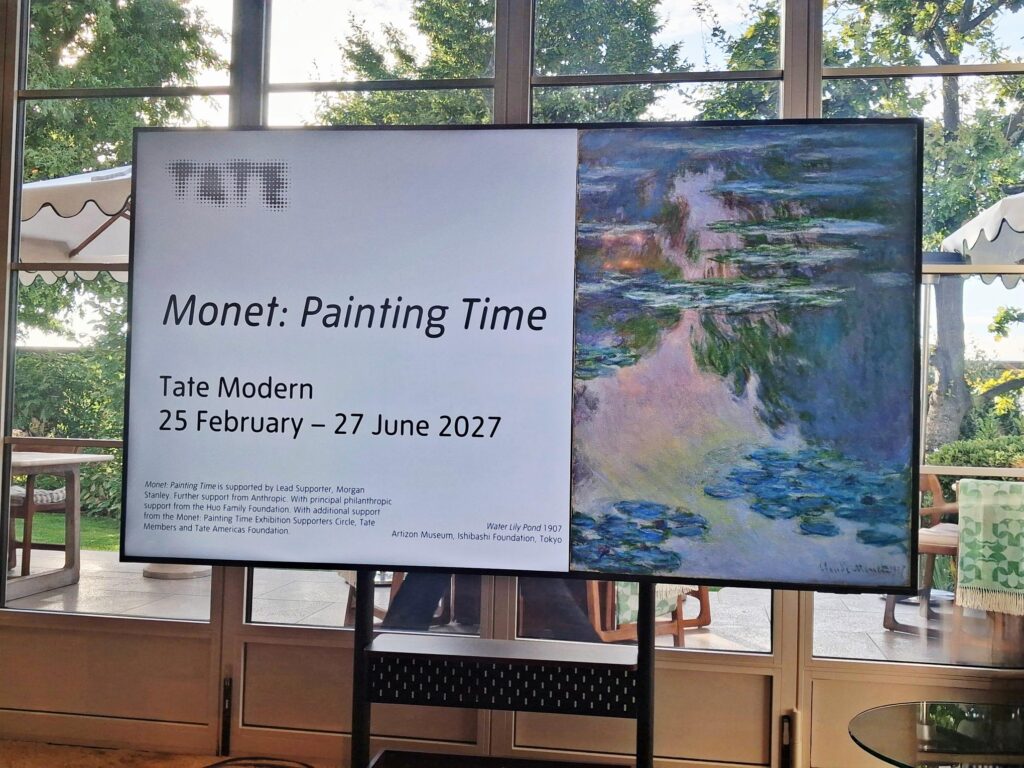
As a Tate Member and a bit of an artist myself, I was absolutely delighted to be invited to the presentation of this major new exhibition. I was a huge fan of Claude Monet as a teenager, and my fascination with Impressionism has never really gone away. So when I first read about Monet: Painting Time in the Tate magazine, I was immediately intrigued.
Having the opportunity to attend a full presentation by Tate’s Acting President and the exhibition curators was an absolute honour and privilege. And, I have to say, I am completely sold.
What makes this exhibition particularly fascinating is that it isn’t simply a collection of Monet’s most famous paintings. Instead, it explores something fundamental to his way of working: his fascination with time and change.
Throughout his career, Monet repeatedly returned to the same subjects, painting them at different moments, in different weather, seasons and light. The subject might remain almost exactly the same, but the painting could feel completely different. That idea is at the heart of Monet: Painting Time.
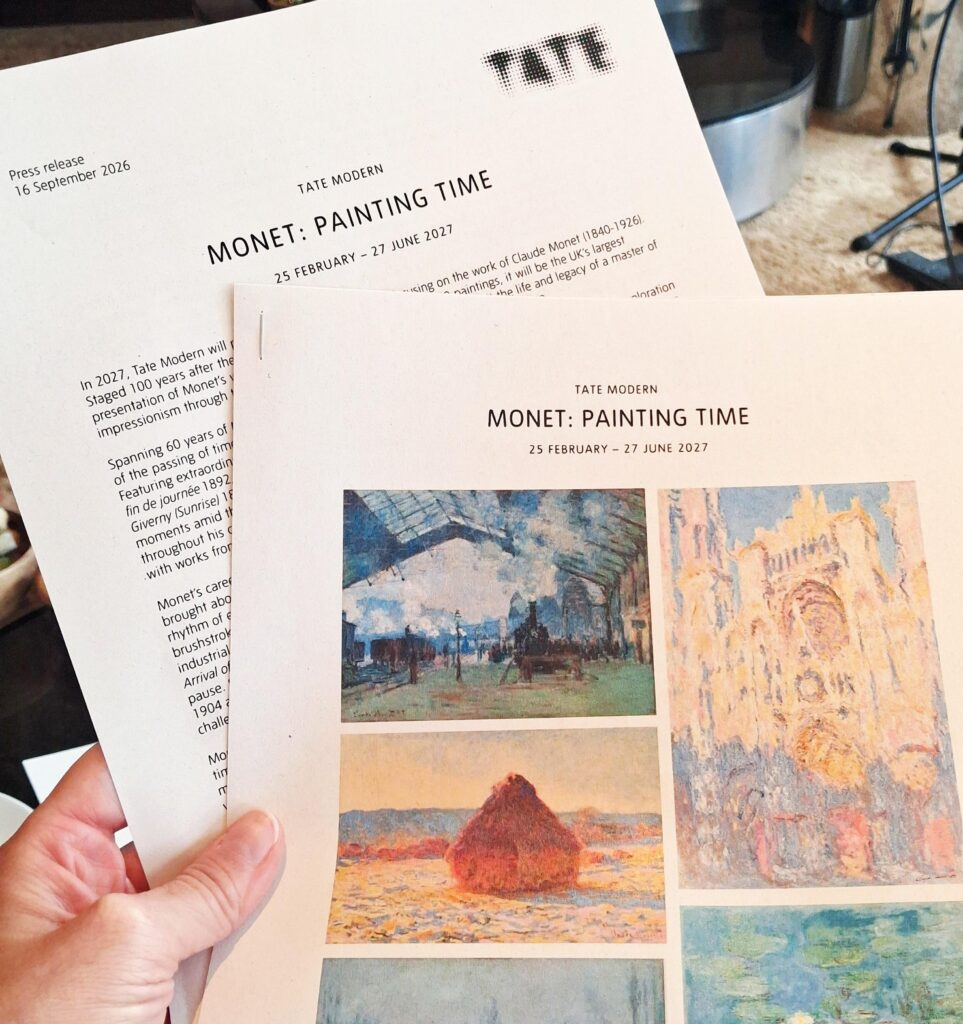
The exhibition will bring together more than 60 paintings spanning around six decades of Monet’s career, from the 1870s through to the 1920s. It will be the UK’s largest presentation of Monet’s work in nearly a decade and, particularly excitingly, will include a remarkable group of paintings from his celebrated series. Among the highlights will be works from the Water Lilies, Poplars, Rouen Cathedral and Haystacks series, alongside paintings exploring modern life and the changing urban landscape.
There is something rather magical about seeing several versions of a familiar subject together. Instead of asking simply, “What is Monet painting?”, we start asking, “What has changed?” The light. The atmosphere. The season. The time of day. And, ultimately, our own perception.
One of the exhibition’s biggest attractions will be the opportunity to see 20 Water Lilies paintings together, many of which have never been exhibited in the UK. For anyone who loves Monet, this is a very big deal. The paintings come from important collections around the world, including institutions in Japan, France and the United States.
The story behind the Water Lilies is fascinating too. Monet began painting his famous water garden at Giverny in the late 1890s, after creating an increasingly elaborate garden inspired partly by Japanese aesthetics. The pond, water lilies, flowers and Japanese-style bridge became an extraordinary source of inspiration for the artist. And Monet didn’t simply paint it once. He kept looking. He kept returning to it. He kept noticing something different. That is perhaps one of the loveliest things about Impressionism: the world hasn’t necessarily changed, but the way you see it has.
The exhibition will also explore Monet’s response to the rapidly changing world around him. The 19th century was experiencing huge technological and social changes, including the rise of the railways. Monet was fascinated by modern life and by the fleeting effects of light and atmosphere. His paintings of Gare Saint-Lazare, for example, capture the energy of the modern railway station in a way that feels surprisingly contemporary. Other works show London bridges disappearing into smoke and mist, with Monet once again interested in how atmosphere could transform an everyday scene.
It is this constant experimentation that makes his paintings so compelling. He wasn’t simply recording what he saw. He was exploring how a moment feels. This is exactly what Monet: Painting Time invites us to do. Slow down. Look again. Look differently.
And perhaps that is why I am already imagining myself going back more than once. My Tate Member perk, and my Monet experiment! This is where I am going to make a little promise to myself. One of the things I loved most about the presentation was the idea that Monet could return to the same subject over and over again, each time producing something slightly different. I want to do the same with this exhibition. Not paint it, obviously, but experience it repeatedly. I want to see Monet: Painting Time when I’m excited about it, when I’m tired, when I have time to linger in front of a painting and when I perhaps only have an hour. I want to see which works grab my attention on my first visit and which ones I completely overlook. Then I want to come back and see what has changed, both in the exhibition and in me.
Because that’s the beauty of art. Sometimes the artwork hasn’t changed at all. You have. And suddenly the same painting can make you feel something completely different. Compliments of the Tate Membership card, I suspect I will be putting this particular exhibition to the test!
So save the date. Monet: Painting Time will be at Tate Modern in London from 25 February to 27 June 2027.
An extraordinary opportunity to see works by one of the world’s most celebrated artists brought together across the different stages of his career. For families, art lovers, budding artists, Impressionism fans or simply anyone who enjoys getting lost in a beautiful painting, this is one to put on the calendar now.
I certainly have.

Hi, I’m Francesca! I live in central London and I’m rarely home — there’s always a gallery, gig, or show pulling me out the door. My real loves are music, art and theatre, but I’m just as happy exploring history, sport, or whatever’s newly opened and worth talking about. I’m on a constant search for London’s most enriching experiences, big and small, and I’m here to help you find them too.
