

I know what you are thinking. Monica, why are you dragging us to a conference about Leonardo da Vinci’s old papers? Because, my darlings, this is not a dusty lecture. This is a detective story. A digital heist. And it happened right under the nose of Casa Italia next to Buckingham Palace.
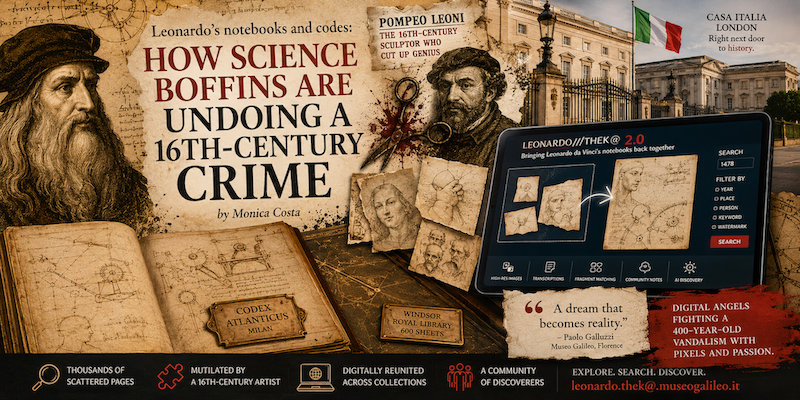
Yesterday I slipped into the new Italian embassy in London, a stunning building overlooking the Royal residence, for the launch of Leonardo//thek@ 2.0. The name is a mouthful. But what it does is pure magic. It takes the thousands of scattered, mutilated pages of Leonardo da Vinci’s notebooks and starts putting them back together, like the world’s most important jigsaw puzzle. And the villain of the piece? A 16th century sculptor with scissors.
The man who cut up genius
Let me introduce you to Pompeo Leoni. An artist, sure. But also, in the eyes of every Leonardo scholar, a monster. In the late 1500s, Leoni got his hands on a huge pile of Leonardo’s original notebooks and loose sheets, the raw thoughts, drawings, and scribbles of the greatest mind of the Renaissance and possibly of all time. And what did he do? He cut them up. He chopped pages into pieces. He glued them into two giant albums, organising them by subject rather than by date or original notebook. He made scrapbooks… a real crime, seen with our contemporary eyes.
One album became the Codex Atlanticus, kept in Milan’s Ambrosiana Library. The other ended up in the Royal Library at Windsor Castle, just down the road from where we were sitting. Between them, they hold more than a third of everything Leonardo ever wrote and drew. But they are a mess. Pages torn in half. Drawings separated from their original text. A beautiful, chaotic, heartbreaking jumble.
Paolo Galluzzi, the former president of the Museo Galileo in Florence, called it the cammino del gambero, the crawfish path. Going backwards, painstakingly trying to reconstruct how Leonardo’s workshop looked on the day he died in 1519. “A dream that becomes reality,” he said. And he almost looked like he was about to cry.
Enter the digital angels
That is where Leonardo//thek@ comes in. Version 1.0 launched in 2023 and covered only the Codex Atlanticus (1,200 pages). Version 2.0, launched this spring, now integrates the 600 sheets from Windsor. For the first time, scholars, and any curious person with an internet connection, can search across both collections. You can look for a specific year, a place name, a person. You can see high-resolution images of the original pages, read transcriptions, and, most excitingly, re-attach fragments that Leoni cut away.
Remember those cut?out bits? Leoni didn’t throw them away. He pasted them into the other album. So a missing corner of a drawing in Milan might be hiding in Windsor. The digital platform lets you virtually stitch them back together.
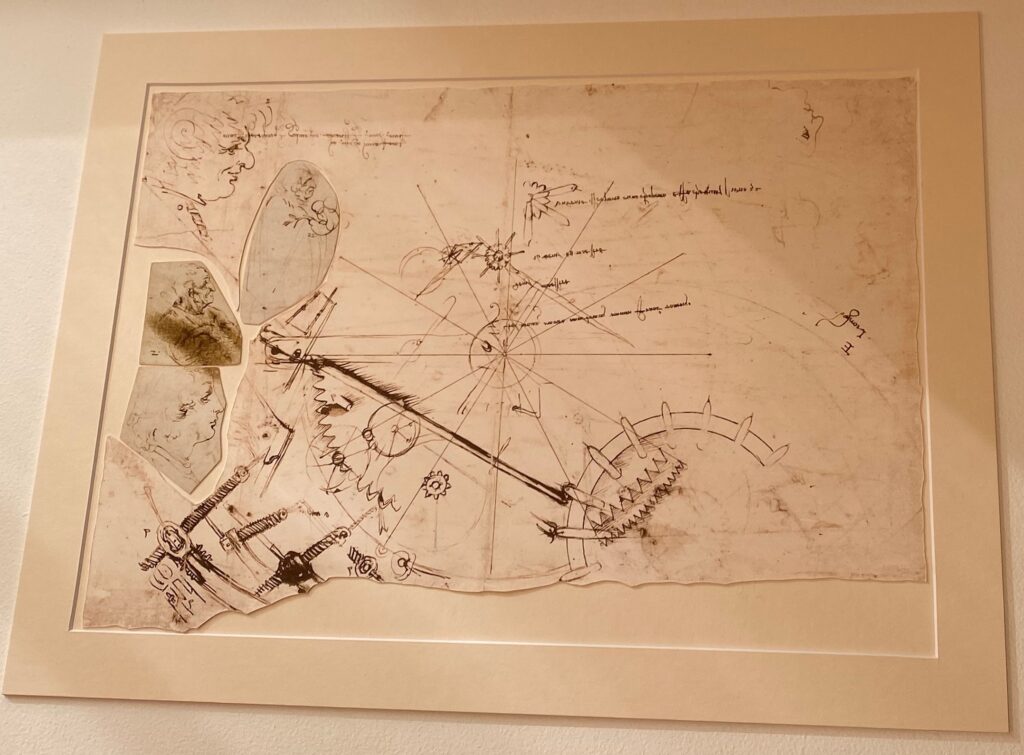
Carlo Vecce, a Leonardo expert from Naples, gave us a live demonstration that made the room gasp. He picked a single sheet from 1478, a year when a 26-year-old Leonardo was in trouble. The Pazzi conspiracy had just exploded in Florence, and Leonardo fled to the countryside with his uncle Francesco. On a large sheet of notary paper (the kind his father used, not artist’s paper), Leonardo sketched clock gears on one side. But on the other side, he drew two faces: a young woman, and a chubby, smiling man. Vecce believes that smiling man is Uncle Francesco.
Then he showed us the holes. Literal holes in the page. Leoni had cut out three small fragments, a beautiful adolescent head, a baby’s hand, and two caricatures of old men, and moved them to Windsor. The digital platform let Vecce drag those fragments back into place. Click. They fit perfectly. The audience applauded. It felt like watching a cold case solved in real time.
Why should a London mum care?
Because this is not just for academics. It is for anyone who has ever looked at a Leonardo drawing and wondered: what was he thinking? It is for your teenager who loves art, or your nerdy husband who watches restoration videos on YouTube. It is for you, on a rainy Sunday, when you want to lose yourself in the mind of a man who drew flying machines, swirling water, and the smile of a mysterious woman, all on the same scrap of paper.
The platform is free. You do not need to speak Italian (though it helps). The search tools let you filter by date, place, keyword, or even by the watermark on the paper, because paper makers’ marks can tell you where and when a sheet was made. Carlo Vecce said: “Start with advanced search. Put in a year. Put in a name. See what happens.”
I tried it when I got home. I typed “1478” and “Francesco da Vinci”. Up popped the very sheet we had seen. I felt like Indiana Jones in my pyjamas.
What comes next?
The team at Museo Galileo wants to keep going. Leonardo//thek@ 3.0 will add other collections, like the Codex Arundel in the British Library. And they are eyeing artificial intelligence to help answer questions that would take a human decades. Imagine asking the system: “Show me all Leonardo’s drawings of water vortices before 1500.” Or: “Which sheets use the same paper as the one with the clock gears?” AI could find patterns we have never seen.
But as Paolo Galluzzi warned, the platform is not a passive library. It is a living tool. Scholars and even amateur enthusiasts will be able to add notes, corrections, and new discoveries. “It becomes a community instrument,” he said. “Not a digital mausoleum.”
A final thought from your Italian editor
I left the embassy feeling oddly emotional. There, in a room full of ambassadors, curators, and professors, I watched a group of people undo a 400-year?old act of vandalism with nothing but patience, pixels, and passion. They cannot bring Leonardo back. But they are giving us the next best thing: a chance to hold his scattered thoughts in our hands, virtually, and say, “Ah, that’s where that piece belongs.”
So go on. Visit leonardo.thek. Let your kids click through the pages. Show them the man who drew a helicopter five hundred years before anyone flew. And tell them the story of the bad sculptor with scissors, and the good guys who fought back with code.
That is a bedtime story worth telling.

Monica Costa founded London Mums in September 2006 after her son Diego’s birth together with a group of mothers who felt the need of meeting up regularly to share the challenges and joys of motherhood in metropolitan and multicultural London. London Mums is the FREE and independent peer support group for mums and mumpreneurs based in London https://www.londonmumsmagazine.com and you can connect on Twitter @londonmums
