

Most new parents feel an overwhelming responsibility to keep their new baby safe. It can be extremely frightening bringing them home and caring for this vulnerable little being.
Feeling overwhelmed
Factor in hormones, sleep deprivation, a sense of responsibility and desire to protect their new son or daughter, coupled with information overload – with often conflicting advice – and its easy to see why new parents can feel daunted.
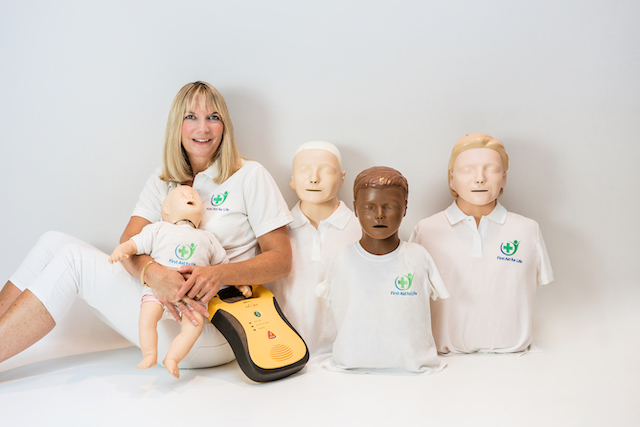
Best buy for new parents
One of the best investments any couple can make when they know they are about to become parents it by attending a first aid course. Especially since, as a parent it is likely that you will be the first on hand if anything goes wrong or first aid is required
Children Accidents happen
Yet we all know that as vigilant as we try and be, it is impossible to watch our children every second of the day. And no environment can ever be 100% safe. Accidents will happen.
In fact, every year, around 2 million children attend A&E due to accidents. Over 100,000 of these require admission to hospital – that is nearly 2,000 children a week – with many more are treated by their GP’s, parents and carers.
Accidental injuries are one of the most common causes of death in children over one year of age in the UK and every year they leave many thousands permanently disabled or disfigured.
Peace of mind for parents
Attending a first aid course will mean you can let your children develop and flourish, experiencing inevitable minor bumps and bruises, with the peace of mind you have the knowledge and skills to recognise and help if something is more seriously wrong. As a parent it is likely that you will be the first on hand if anything goes wrong or first aid is required.

Life and death
Basic first aid can mean the difference between life and death. Furthermore, it can massively affect the extent of your child’s recovery, the amount of pain they’re in and how long they need to be in hospital. Prompt first aid can even lead to someone recovering completely without the need for medical intervention at all!
Recognising when things are wrong
Many parents book onto our courses when they’re pregnant, some wait until their babies have arrived and still more are prompted when they start weaning.
The advice is to gain these skills as soon as you can. Moreover you will gain peace of mind from knowing that you are able to recognise if something is seriously wrong and know how to help. Parents can book on as individuals, arrange a group course at a time and place to suit them, or learn at work.
Keep your skills fresh
Training must be refreshed regularly to ensure the information is current and fresh in your mind in case you need to jump into action. Refreshers can be practical or online. The most important message is not to let yourself be in the position of wishing you had known what to do.
Most common accidents
Therefore, we look at three of the most common first aid emergencies in the under 5’s – burns, choking and head injuries – and provide a step by step guide to show parents how to help.
Choking
Babies love to put things in their mouths and anything small enough to fit through a loo roll can prove a potential choking hazard. When starting solids, cut foods into sticks rather than into perfect circles as these could completely block the airway.
Babies have sensitive gag reflexes and often appear to struggle when trying new food textures and this can be frightening. The majority of the time they manage to clear the obstruction themselves, repositioning them with their head lower than their body can help. Keep as calm as you can as they will quickly pick up on panic and this can make things worse. If they are able to cough encourage them to do so. However, if they are quiet and struggling to breathe, help immediately.
Choking – how to help

- Stay as calm as you can.
- If they are able to cough, reposition them to see if they can clear it themselves.
- Have a quick look in the baby’s mouth and carefully remove anything obvious. NEVER blindly sweep inside the baby’s mouth with your fingers as it can cause damage and push the obstruction further down.
- Lay the baby downwards across your forearm, supporting under their chin.
- With your hand hit the baby up to 5 times firmly between their shoulder blades
- Check after each back blow to see if the obstruction has cleared
- If still choking; lay the baby on its back across your knees, head downwards. Place two fingers in the centre of their chest at the nipple line, and give up to?five, firm upward chest thrusts.
- If the baby is still choking, call 999/112 and continue giving baby?five back blows, alternated with five chest thrusts, until help arrives
- If the baby becomes unconscious start CPR immediately.
Burns and Scalds
Burns are horrible. The pain and damage caused can be devastating. Knowing what to do following a burn or scald can make a massive difference in reducing the amount of pain and scarring. In addition it may avoid them having any tissue damage at all. A hot drink that was made nearly 10 minutes ago can still be hot enough to scald a baby.
For All BURNS – TREAT THEM IMMEDIATELY WITH COOL RUNNING WATER FOR A Full 20 MINUTES
Immediately, but extremely carefully remove loose clothing covering the burn.
DO NOT TAKE CLOTHES OFF IF THERE IS ANY RISK THAT THE SKIN HAS STUCK TO THEM OR IF THE SKIN HAS BLISTERED.
- Hold the affected area under cool running water for a full 20 minutes
- Reassure the child and keep them warm and dry. Be aware of any signs of clinical shock
- Phone an ambulance; particularly if a large area is affected, if the skin is broken or blistered, or if they show signs of shock and keep the area under cool running water whilst you are waiting for the ambulance.
- Never?touch the burn, pop blisters, or put on any creams whatsoever. Take burns very seriously and always seek medical advice.
Always get a medical professional to assess a burn.

Head Injuries
Babies and children often bang their heads. It can be difficult to assess how seriously they are hurt. Fortunately, most head injuries are superficial or merely injure the scalp, which is usually more frightening than life threatening; the head and face are very vascular and consequently bleed profusely. A severe blow to the head or repeated injuries can cause damage to the brain and this is far more serious.
What to look for following a head injury:
- Call 999 or 112 if your baby loses consciousness, even momentarily or if a child of any age has any of these symptoms:
- won’t stop crying
- complains of head and neck pain
- isn’t walking normally
If the child is?not?an infant, has?not?lost consciousness, and is alert and behaving normally after the fall or blow:
- Apply a wrapped ice pack or instant cold pack to the injured area for 10 minutes.
- Observe your child carefully for the next 24 hours. If you notice?any worrying signs (see below), get medical help immediately.
- Take care If the incident has occurred close to bedtime or naptime and your child falls asleep soon afterwards. Check in continually to look for anything unusual – in particular, twitching limbs or disturbances in colour or breathing. It is perfectly ok for your child to go to sleep. There is no need to keep a child awake after a head injury.
However do not confuse falling asleep with losing consciousness
About us
Written by Emma Hammett
First Aid for Life provide award-winning first aid training tailored to your needs. Please visit our site and learn more about our practical and online courses. It is vital to keep your skills current and refreshed.
It is strongly advised that you attend a fully regulated Practical or Online First Aid course to understand what to do in a medical emergency. Please visit?https://firstaidforlife.org.uk?or call 0208 675 4036 for more information about our courses.
First Aid for Life is a multi-award-winning, fully regulated first aid training provider. Our trainers are highly experienced medical, health and emergency services professionals who will tailor the training to your needs. Courses for groups or individuals at our venue or yours.
First Aid for life provides this information for guidance and it is not in any way a substitute for medical advice. First Aid for Life is not responsible or liable for any diagnosis made, or actions taken based on this information.

Emma Hammett is the CEO and Founder of First Aid for Life. First Aid for Life is an Award Winning fully regulated First Aid Training business, our trainers are extremely experienced medical and emergency services professionals and our training is tailored to your needs.
We give people the skills and confidence to help in an emergency.
Emma Hammett is a First Aid expert and is regularly contacted as a spokesperson for SKY News and the BBC, she is the First Aid expert for Mothercare.
First Aid for life provides this information for guidance and it is not in any way a substitute for medical advice. First Aid for Life is not responsible or liable for any diagnosis made, or actions taken based on this information. The best way to be prepared for action in an emergency is to attend a practical First Aid course.
For more information please visit: www.firstaidforlife.org.uk or contact emma@firstaidforlife.org.uk 0208 675 4036
